Showing posts with label America. Show all posts

Friday, July 4, 2014

I Love My Country, But I Can't be Patriotic Anymore

This Fourth of July, I have a confession to make.

I used to wake up every Independence Day morning with "God Bless America" on my lips.  I used to feel a thrill of excitement and reverence when I faced the flag and pledged allegiance, when I put my hand over my heart and sang along with The Star-Spangled Banner.

I still say the Pledge.  I still put my hand over my heart, and I still sing the National Anthem. I still love America.

But the old thrill is gone.  Flag-waving and loud singing just embarrass me now. I'm like a teenager remembering when I loved to run to my mother and hug her in front of everyone-- and now I don't want to make her sad, but I'm just not going to hold her hand in public anymore.

Today I still plan to barbecue and eat with my family at a table decorated with stars and stripes.  And then I want to go and watch the fireworks-- they'll probably still make my breath catch in my throat, still made my cry "Oooh!" with the rest of the crowd.

But though I still truly hope God will bless America, I just don't wake up singing about it nowadays. I don't want to put flags out on my lawn.  And I don't want to wear one on my shirt with a message that gets in everybody's face about either loving the USA or leaving.

I don't want to be "patriotic."  Because as far as I can see, that word has come to mean something different than just caring about my country and wanting the best for it.

For example, The American Patriot's Bible.

Here's the book's summary from Amazon.com:
THE ONE BIBLE THAT SHOWS HOW ‘A LIGHT FROM ABOVE’ SHAPED OUR NATION. Never has a version of the Bible targeted the spiritual needs of those who love our country more than The American Patriot’s Bible. This extremely unique Bible shows how the history of the United States connects the people and events of the Bible to our lives in a modern world. The story of the United States is wonderfully woven into the teachings of the Bible and includes a beautiful full-color family record section, memorable images from our nation’s history and hundreds of enlightening articles which complement the New King James Version Bible text.
When we American Christians narcissistically make the Bible all about us-- when we tweak American history to make America seem more virtuous than it ever actually has been, when we say our country is unique, that it has the special favor of God to be the shining "City on a Hill" which  blesses all other nations-- that's the kind of patriotic I don't want to be.

When Christians seek first the kingdom of America-- and not just any America, but a particular flavor of down-home conservative, white, middle-class America-- and believe they are "taking America back for God," that's the kind of patriotic I don't want to be.
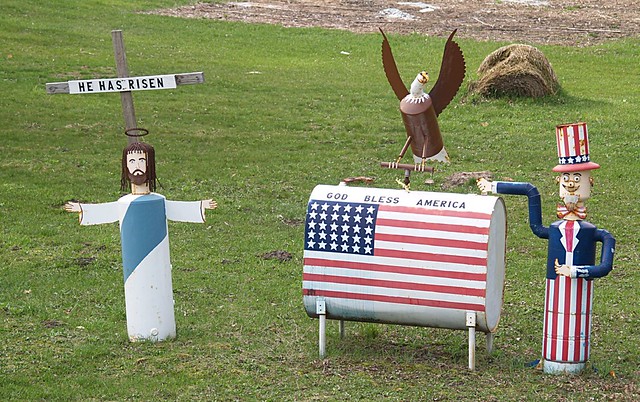
"He Has Risen" & "God Bless America" Lawn Ornaments, On Route 31 (Just North Of Beulah, MI) from Flickr via Wylio
© 2007 takomabibelot, Flickr | CC-BY | via Wylio
And I think the reason I've lost my enthusiasm for displaying the flag publicly, is because I don't want to be associated with this.

If it's going to be about show-off displays of God-and-country devotionalism, then that's the kind of patriotic I don't want to be.

Because when we wrap our Christianity in the American flag, it's bad for both of them.


The other thing is that the more I've learned about American history, the more I realize that America really hasn't been, and isn't now, a shining example of virtue.  America (and particularly white America) has a long history of taking what it wants and vilifying those it takes it from.  Along with our love of country, we need a healthy dose of humility and repentance.

And sometimes the things my fellow Christians insist we most need to repent of, don't seem at all like the things that matter.

We have so much to learn from the good things other countries and peoples have been, have done, have accomplished.  And yet so many times we act as if America alone has anything to teach, and we don't want to listen or learn from anyone.

I don't want to be that kind of American.  But that's what being "patriotic" seems so often to be about.

So I can't be patriotic anymore.

Still, America is my home.  My best memories-- practically all of my memories!-- are about the life I've lived as part of her.  I love the traditions of my part of American culture while recognizing that it isn't all of American culture.  I want America to be inclusive of all her people, to give them all a voice and a place.  I want America to be great, and I want her to be good-- not because she's inherently better than other countries, but because she's mine.

I find that G. K. Chesterton, in his classic book Orthodoxy, has described my feelings:
It is a matter of primary loyalty. The [beloved place] is not a lodging-house at Brighton, which we are to leave because it is miserable. It is the fortress of our family, with the flag flying on the turret, and the more miserable it is the less we should leave it. The point is not that [it]is too sad to love or too glad not to love; the point is that when you do love a thing, its gladness is a reason for loving it, and its sadness a reason for loving it more. . . If men loved Pimlico [a terrible slum] as mothers love children, arbitrarily, because it is theirs, Pimlico in a year or two might be fairer than Florence.
I do love my country like that.  My problem is that Chesterton actually names this attitude "patriotism."

But perhaps it isn't a problem. I suspect that many of the Americans who are the most loudly and obnoxiously nationalistic, somewhere deep down feel as Chesterton described.  Maybe what we really need to do is let go of all that strutting, and get back to the real meaning of "patriotic": what the Online Merriam-Webster's defines simply as "having or showing great love and support for your country."

And then maybe I can be patriotic after all.

Saturday, May 10, 2014

America is Not the New Israel

I'm reading a book for my book club this month that I wouldn't have chosen myself.  It's called The Harbinger by Jonathan Cahn, and it uses a Dan Brown-style fiction approach to communicate the author's idea that certain events in American history are foretold in ancient Bible prophecy.  I'm not going to give an in-depth critique of the book at this time (partly because I haven't finished it!), but I do want to talk about its main premise, because it's a viewpoint that I've heard many times and which I think is doing more harm than good to Christianity in America.

Here it is in a nutshell, quoted directly from the book:
Israel was unique among the nations in that it was conceived and dedicated at its foundation for the purposes of God. . . But there was one other-- a civilization also conceived and dedicated to the will of God from its conception. . . America. . . Long before the Founding Fathers[,] those who laid America's foundations saw it as a new Israel, an Israel of the New World.  And as with ancient Israel, they saw it as in covenant with God. . .  
Not that [America] was ever without fault or sin, but it would aspire to fulfill its calling. . . To be a vessel of redemption, an instrument of God's purposes, a light to the world. . . No nation in the modern world has ever been given so much. None has been so blessed. . .  
[But] America began ruling God out of its life, turning, step by step, against His ways. . . In the middle of the twentieth century America began officially removing God from its national life.  It abolished prayer and Scripture in the public schools. . . removing the Ten Commandments from public view, banning it from its public squares, and taking it down, by government decree, from its walls. . . God was progressively driven out of the nation's public life. . . The standards and values it had long upheld were now abandoned. . . [what we call "tolerance" is] a tolerance that mocked, marginalized and condemned those who remained faithful to the values now being discarded.
The idea that America is the new Israel, the new chosen, covenant nation for God, does indeed go back to the Puritans and Separatists who came to the New World in the 1600s.  It has been part of our national mentality since its inception, and it is one of the main forces behind Christian engagement in the "culture wars" that seek to uphold America's symbolic civil religion as if this outward and cultural religious consciousness were the same as the actual faith that Jesus taught.  The loss of the hegemony of America's civil religion is thus held to be tantamount to the nation's "turning away from God."

But as far as I can see, the whole of the New Testament is against any idea of a new nation taking on the position or status of Israel; indeed, the New Covenant precludes any such notion.  America cannot be the new Israel, nor can it enter into a covenant with God as a nation in the way Israel did, because the New Covenant is about the kingdom of God, not about any nation on earth.

As 1 Peter 2:9-10 says:
But you are a chosen people, a royal priesthood, a holy nation, God’s special possession, that you may declare the praises of him who called you out of darkness into his wonderful light. Once you were not a people, but now you are the people of God; once you had not received mercy, but now you have received mercy. (Emphasis added)
To come to God through faith in Christ is to become part of a new, holy nation. The New Covenant is the covenant in Christ's blood (Mark 14:24) which makes us part of this spiritual nation; it simply does not envision covenants with earthly nations.  Ephesians 2:11-21 speaks of how all who are in Christ are part of one "new humanity" and "fellow citizens with God’s people and also members of his household."  The covenant God has made through Christ is sufficient; additional covenants with earthly nations are not envisioned.  Everything taught in the New Testament about God's covenant in Christ denies the concept of God making a new, Israel-type covenant with any earthly nation, America included. 

And of course, there's also the problem that despite what the Pilgrims hoped for their colony, the idea of America as dedicated to God from its inception is simply not true.  The first American settlement, Jamestown, was a secular colony established for profit and for the expansion of England's power.  The Dutch settlements in what would become northern New England tended towards religious pluralism and tolerance, and since the Dutch were eventually assimilated into the English colonial framework, their ideas became interwoven with the emerging nation's self-understanding:
By their actions, the Founding Fathers made clear that their primary concern was religious freedom, not the advancement of a state religion. Individuals, not the government, would define religious faith and practice in the United States. Thus the Founders ensured that in no official sense would America be a Christian Republic. Ten years after the Constitutional Convention ended its work, the country assured the world that the United States was a secular state, and that its negotiations would adhere to the rule of law, not the dictates of the Christian faith. The assurances were contained in the Treaty of Tripoli of 1797 and were intended to allay the fears of the Muslim state by insisting that religion would not govern how the treaty was interpreted and enforced.John Adams and the Senate made clear that the pact was between two sovereign states, not between two religious powers. (Frank Lambert, The Founding Fathers and the Place of Religion, summarized by Princeton University Press.  Emphasis added.)
The idea that America was founded as a Christian nation and is viewed by God as the new Israel leads to a number of practical problems.

1.  It distracts us from seeking first the kingdom of God.

Jesus said, "Seek first the kingdom of God and His righteousness (Matt. 6:33)."  When we focus on how America is supposedly falling away from its great destiny as God's chosen nation-- when we spend our energy on trying to restore the hegemony of American civil religion-- we can't pay much attention to building oneness as Christians, centered around love and service and the kingdom of God. And yet Jesus never prayed, "That they may all maintain Your Ten Commandments in public places and uphold traditional values throughout the land."  He prayed, "That they all may be one, so that the world may believe that You have sent Me (John 17:21)."

2.  It leads to spiritual pride.

Romans 12:3 says, "Do not think of yourself more highly than you ought, but rather think of yourself with sober judgment, in accordance with the faith God has distributed to each of you."  To think of America as a chosen, covenant nation leads to thinking of ourselves as American Christians (intentionally or not) as somehow more chosen and in a better covenant relationship with God than other Christians.  And when the American civil religion begins to lose its former powerful monopolization of the public square, we begin to think of ourselves as virtuous victims of evil religious persecution-- whether that image is truly accurate or not.

3.  It focuses our attention on minor issues and passes over our nation's greatest sins.

This is the crux of the matter, I think.  When we get distracted by whether Christian "traditional values" have supremacy in the land, and when we decide that making room in the public square for other faiths means America has "abandoned God," we are actually majoring on the minors.  To Israel God once said that far more important than their sacrificial system was "To act justly and to love mercy and to walk humbly with your God (Micah 6:8)."  But throughout its history, these things are exactly what America has failed to do, over and over again.  From the treaty-breaking appropriation of Native American lands and the genocide of Native peoples, to the enslaving of African captives and the disenfranchisement of their descendants, to the internment of Japanese Americans, to the strong-arming of American interests over weaker countries of the world, America has continually shown that it is not truly following Christ and His law of "do unto others as you would have them do unto you."

In fact, the "chosen nation" mentality can act as a justification for this very behavior. As Betty Wood said in The Origins of American Slavery,
In New England, Puritan settlers used slavery to reinforce their image of themselves as religious refugees. Those that could not enter into the covenant and be saved were subject to servitude as approved by Scripture.
And according to this Excerpt from "Joshua and the Promised Land" by Roy H. May, Jr. (on the Joshua Website of the United Methodist Church, Global Ministries):
The sense of divine election and the identification of the Americas with ancient Canaan were used to justify expelling America's Indigenous Peoples from their land. The colonists saw themselves as confronting "satanic forces" in the Native Americans. They were Canaanites to be destroyed or thrown out. . .

Land rights of Native Americans were never taken seriously. Rather, they were seen as obstacles to the colonists' need for land. The Puritans did not respect the farms of Native Americans. They sought "legal" ways to get their land. If a Native American broke one of the rigid Puritan religious laws, the fine was paid by giving up land. In this manner, some Puritans were able to amass large landholdings through the Massachusetts courts. John Winthrop, for example
[the same man who preached that the colony was to be God's "city on hill"!], obtained some 1,260 acres along the Concord River.
If we truly face ourselves, we have to admit that these are America's besetting sins from the time of its inception, and that we ourselves often still participate in systems that harm whole groups of people while even blaming them for what happens to them.  Whether or not children are praying a government-sponsored prayer in school, or whether a copy of the Ten Commandments hangs in our public buildings-- these are really beside the point, aren't they?

To act justly, love mercy and walk humbly with God.  To trust, believe in and follow Jesus, to love as He loved, to serve as He served.  This is what we are meant to be doing.

Not to be struggling and striving to keep America from "falling away" from something it never was in the first place.

America is not the new Israel.  No nation is, or should be.  This would be a good time to let go of the myth.

Saturday, August 24, 2013

Perceptions of Racism: Why We Need a Double Standard

This image has recently been displayed on Facebook, and I want to talk about it this week:


You can view a portion of the incident on CNN here. The Huffington Post also published an article detailing what had happened and some of the reactions to it:
As some people at the Missouri State Fair see it, the rodeo incident last weekend in which a ringleader taunted a clown wearing a mask of President Obama and played with his lips as a bull charged after him was neither racist nor disrespectful. It was a joke, they said, overblown by a news media that’s hypersensitive to any possible slight against the nation’s first black president. 
The rodeo incident and the clown at the center of it have become the latest illustration of racial divisions that continue to surface nearly five years into Obama’s presidency. . . Democratic and Republican elected officials in Missouri quickly condemned the incident, saying it was offensive and inappropriate. . . .
But there has also been a backlash on the right, with conservative radio talk show hosts and writers dismissing the act as a joke no different from jabs aimed at other presidents. Moreover, they said, the president’s supporters ought to learn how to take a joke rather than seeing everything as racially motivated.
There is a long history of mocking politicians at rodeos, and clowns have donned masks of other presidents as part of their acts. But James Staab, a political science professor at the University of Central Missouri, said last week’s incident “goes beyond the pale — they’re talking about physical injury and racial stereotypes.” 
To be fair, there is naturally going to be a difference in the way a rodeo clown dressed as a Democratic President is treated by the conservative, rodeo-going crowd of Missouri, compared to the way they would treat a rodeo clown dressed as a Republican and fellow Southerner like George H. W. Bush.  It's not surprising that the crowd demonstrated more verbal animosity towards the Democrat, and race may or may not have been a factor in that.  But that's not really what the problem is with the Facebook meme.

I also don't think it's all that helpful to focus on whether the Obama clown depiction was "racially motivated," as the Huffington Post puts it.  It's difficult and often unproductive to try to determine what people's motives are in a situation like this.  But there is an issue.  And the issue, as far as I can see, is not so much about what motivated the incident, but about what actually happened.

You see, I'm not talking about racial motivations, but about racism.  I think these are actually two things that overlap, but are really not the same.

I do think the Obama mask is racist, even though there was a similar mask of Bush that obviously wasn't.  One reason I think so is the simple fact that the Obama mask overemphasizes certain stereotypical characteristics associated with black people, such as large white teeth, in a way that simply doesn't apply to the Bush mask.  Another reason is that depicting African-Americans as clownlike and stupid is a historical practice of the dominant white culture in the U.S., and as such, it isn't funny when we do it today.  Based on our history as a nation, there are ways you can lampoon a white man that you can't lampoon a black one-- because the scars are still there, and this sort of thing isn't going to help heal any of them.

But there's more to it even than that.  

I want to talk about institutional, systemic racism-- the kind that isn't about "motivation." The kind that people participate in without intention, and often without even consciousness of doing so.  The fact is, that it's quite possible-- even easy-- to participate in systemic, institutional racism without in the least intending to be racist.  All you have to do is go along with the status quo.

That's not to say that there is never any actual, deliberate, racially motivated animosity towards our current President.  I'm sure sometimes there is.  But when it comes to racism, it's quite possible to participate in it without deliberate racial motivation at all.

Back in 2009, blogger Rod at Political Jesus identified a particular characteristic of conservative evangelicalism, which he spoke of in terms of sexism, but which easily apply to racism as well.  He said that conservative evangelicalism has
a highly individualistic view of sin–an idea that individuals alone are judged according to their sins and actions. . . 
[Thus they] discredit any theological notion of corporate sin, and therefore discredit the claims of [persons experiencing systemic injustice] since institutional sin does not exist. If institutional sins such as institutional sexism does not exist, then [such] claims cannot be explained except for anything but a “conspiracy theory.”
But this is not about a secret plot that a few people claim exists.  This is about real events that happen, real ways that people get treated, which are not part of any conspiracy, but just a factor of our ongoing social structures. Yes, Virginia, there is such a thing as institutional, corporate sin, and systemic racism is one of them.  If sins were only individual, why would Jesus speak as He did in Matthew 11:20-24?
Then He began to rebuke the cities in which most of His mighty works had been done, because they did not repent: "Woe to you, Chorazin! Woe to you, Bethsaida! For if the mighty works which were done in you had been done in Tyre and Sidon, they would have repented long ago in sackcloth and ashes. . . And you, Capernaum, who are exalted to heaven, will be brought down to Hades; for if the mighty works which were done in you had been done in Sodom, it would have remained until this day."
An article in Watchman Magazine Online by Marc Smith explains a little bit about what might have been the corporate sin of Capernaum:
Capernaum was located in a very advantageous place (Matthew 11:23, "And you, Capernaum, who are exalted to heaven..." This reference the Lord makes might have had to do with the attitude of its inhabitants more than any other factor.) in that it was on a crossroads of primary importance, being along the Beth-shan, Damascus highway. The presence of Roman soldiers at Capernaum (Mark 8:5-13) illustrates the importance of Capernaum's location. (Emphasis in original)
If Capernaum as a city could have been considered guilty of corporate pride by Christ, how can we say there is no such thing as corporate sin?  As long as we look at sin as only an individual thing, we will probably fail to see that we may be participating in systemic societal sin, simply by remaining blind to it and thus just going along with the way things are.

So what does systemic racism look like?  How does it relate to the way the Obama mask is perceived, versus the way the Bush mask is perceived?

This article on white privilege details several differences between being a white person and a person of color in America.  I think one aspect in particular applies here:  that in ways a white person will never experience, a person of color is viewed less as an individual and more as a representative of his or her entire race.   Here are some examples from the article, detailing conditions which people of color cannot count on, but which white people often take for granted:
I can swear, or dress in second hand clothes, or not answer letters, without having people attribute these choices to the bad morals, the poverty, or the illiteracy of my race.
I can speak in public to a powerful male group without putting my race on trial. 
I can do well in a challenging situation without being called a credit to my race.
I am never asked to speak for all the people of my racial group.
White people in our culture (and particularly white men) are usually looked at as individuals.  White is normative; white is the default.  You don't get noticed for being white in our society.  You aren't considered primarily as a member of a group known as "whites."

What this means for the rodeo clown mask incident (as my husband so pithily pointed out the other evening), people in general aren't going to look at the Bush mask and say, "Oh, look at the funny white man."

But  that's not the case with the Obama mask.  When people look at the Obama mask, the tendency, learned from our culture and passed down generationally, is to see a mask of a black man first, and of a man named Barack Obama second.

What this means is that we can't put a rodeo clown in an Obama mask without its being seen as a mockery, not just of our President, but of the entire black race.  Even if we don't intend it to be seen that way.  Even if that's the last thing on our minds.

Is this fair?  No.  But it's the way things are.  So to get offended when people say, "That's racist!" is to continue to walk in the privilege of not having to notice that it's not the same to be black in our country as it is to be white. 

I think it's important as a white person not to take this too personally.  To have someone point out that something we're participating in is racist, isn't necessarily an indictment on our character.  Instead, we can see it humbly, as a time to learn to let go of privilege.  It's time to learn to see through the eyes of those our race has traditionally and repeatedly othered.  We need to understand why the Bush rodeo mask and the Obama rodeo mask really aren't the same thing-- and why it's not hypocrisy to say so.

As white people, we tend to want to ask, "Then is the only way to not be perceived as racist, to treat people of color with more consideration than we treat ourselves?

Well-- yes.

Because we can't clean up a mess by pretending it's not there.  We can't just say, "As long as I'm not making a new mess, it's ok."  We can't just say, "I wasn't the one who made that old mess, and it's not my fault or my responsibility."  That doesn't matter.  We inherited this mess of systemic racism that's been here all these years, and we have to roll up our sleeves and bend down to work on cleaning it up. To pretend it isn't there ends up just being a way to leave it in place.

And that means that, until black and brown people are really free from institutional and generational racism, there has to be a double standard.

It's the least we can do.  Isn't it?

Saturday, July 20, 2013

Weeping with the Parents of Trayvon Martin

With so many people blogging and so many news articles about Trayvon Martin and the George Zimmerman trial, I've wondered what I could possibly add that hasn't already been said.  But I'm a mother of teenagers myself, and I know Trayvon Martin's parents are weeping.  I must weep with them.

And in solidarity with them, and with parents like them everywhere, I must stand up and respond to the voices who are saying "This wasn't about race."

Actually, it was.  It is.  I'm not going to weigh in on whether George Zimmerman should have been convicted or not; I have been a member of a jury before, I think the jury did the best they could to arrive at the best verdict they could come up with given the instructions they were given in the criminal trial process.  But to say this incident, as it arose, as it progressed and as it horrifically concluded, was not about race, is to speak from the luxury of not having to live as Trayvon Martin and his family have always lived: in a world where, like it or not, race is what it's about-- on a daily basis.

Blogger Caryn Riswold puts it like this in her article "I Am Not Trayvon Martin":

In the months leading up to the trial of George Zimmerman, #IAmTrayvonMartin became a popular hashtag, a way for people to show support, empathy, solidarity. I think it’s important for me and all white people who work for racial justice to say: I Am Not Trayvon Martin. Like [other middle-class white people] . . . I generally perceive law enforcement to exist in order to protect me. I will not be hunted down on the street because of the color of my skin. I will not be suspected of stealing the nice car I might be driving or trying to get into. I have never been followed in a store by a clerk who is afraid I might steal something.

Understanding this is a base level of awareness of white privilege, necessary in order to dismantle the system that declares open season on young black men.


As a white person, I need to step away from the luxury of not being required to think about this.  If I'm going to follow Jesus, I need to follow "do unto others as you would have them do unto you." That means trying to see through their eyes.  It means trying to understand what my life would be like if I were them.

White privilege is "an invisible package of unearned assets which I can count on cashing in each day, but about which I was ‘meant’ to remain oblivious . . . like an invisible weightless backpack of special provisions, maps, passports, codebooks, visas, clothes, tools and blank checks."  Certain realities that I take for granted in my life-- realities that make my world easier for me and my children to live in-- simply do not exist for the person of color who might be walking down the street next to me.

White privilege means my son, if he goes out to get a snack in the evening-- even if he's wearing a hoodie-- will not automatically look over his shoulder.  No one has ever told him-- or had to tell him--that his very presence might be perceived as a threat.  If a policeman or someone in a neighborhood watch stops him, he might be startled or even nervous-- but he has no ingrained expectation that the confrontor is already most likely set against him, or that harm to him might result.

So I'm trying to think what it might be like to be Sybrina Fulton, Trayvon's mom.  Could I even let my son have the freedom a teenage boy needs as part of growing up, to leave the house and hang out with his friends, if I knew what Sybrina knew?  If I knew that the assumptions people were most likely to make about my son were not that he is probably peaceful and law-abiding, but just the opposite?

If I knew that my son also knew this-- knew that the deck was stacked against him before he even walked out the door?

That he might become wary and defensive as a result?

That his very wariness and defensiveness were most likely to be interpreted as dangers?

Blogger Libby Anne has written a piece on George Zimmerman and Race in America, in which she pulls together the results of a group of studies that make it clear that Trayvon Martin was no isolated case.   That there is a "subconscious but measurable preference to give white men the benefit of the doubt in these ambiguous situations."  (Sociological Images: Who Would You Shoot?)

That "[w]e are already biased in favor of the white defendant and against the black victim." (Sociological Images: Stand Your Ground Increases Racial Bias)

That "[a] finding of “justifiable homicide” is much more common in the case of a white-on-black killing than any other kind including a white and a black person." (Ibid.)

And this is exacerbated by the recent Stand Your Ground Laws which were in effect in the Martin-Zimmeran interaction, in which "a misinterpretation of physical clues could result in the use of deadly force, exacerbating culture, class, and race differences" resulting in "a disproportionately negative effect on minorities, persons from lower socioeconomic status, and young adults/juveniles."

What would it be like for my family, to have this be our reality?  And how can we so confidently say, having never experienced this reality, that Travyon Martin's death was not about race? 

As MSNBC's Analysis states: 

Many legal analysts, convinced that the prosecution did not have enough evidence to prove its case, had predicted the acquittal even before the trial began. Reasonable doubt, they said repeatedly. The state must persuade the jury beyond a reasonable doubt.

But reasonable doubt is an elastic standard, and it seems to work in favor of whites much more often than it does blacks. It is hard to imagine that a black “neighborhood watch volunteer” who pursued and killed a white kid under the same circumstances would have walked away a free man.

So I weep with Tracy Martin and Sybrina Fulton.  And I hope that somehow I can come alongside them to work for a different reality.  Because, like it or not, their reality is my reality. "No man is an island," John Donne famously said.  White privilege might give me many a free pass through situations that undermine my brothers and sisters of color, but those situations are part of the world I must live in, whether I blind myself to it or not.

An article in The Atlantic called "Trayvon Martin and the Irony of American Justice" put it in a nutshell for me:

The injustice inherent in the killing of Trayvon Martin by George Zimmerman was not authored by a jury given a weak case. The jury's performance may be the least disturbing aspect of this entire affair. The injustice was authored by a country which has taken as its policy, for the lionshare of its history, to erect a pariah class. The killing of Trayvon Martin by George Zimmerman is not an error in programming. It is the correct result of forces we set in motion years ago and have done very little to arrest. . . You should not be troubled that George Zimmerman "got away" with the killing of Trayvon Martin, you should be troubled that you live in a country that ensures that Trayvon Martin will happen.

This is the nature of American justice.  And it is deeply, fundamentally unjust. And because of it my son is safe, while Tracy and Sybrina's son is dead.

How can I keep from weeping? 

Saturday, May 4, 2013

"In God We Trust," Prayer in Schools & Manger Scenes: Why We Shouldn't Fight for Them

According to many Christians in the United States today, such as Benjamin Hart, president of the Christian Defense Fund, there is "a relentless assault on America's religious institutions and traditions by our educational system, the courts and throughout our popular culture."  The authors of One Nation Under God: America's Christian Heritage state in their introduction:

"[O]ur schools have been wiped clean of Christian influence, [and] efforts are underway by anti-Christian legal groups to completely "sanitize" our nation of any Christian references by,
  • Removing "In God We Trust" from our currency.
  • Ending opening each session of Congress with prayer.
  • Ending Christmas as a national holiday.
  • And eliminating the rank of military chaplain from our armed services."
It is interesting that according to Charisma News, this perception among Christians is largely limited to evangelicals, with other groups tending to believe that Christianity is simply being asked to share the public square:

"The findings of a poll published Wednesday, reveal a 'double standard' among a significant portion of evangelicals on the question of religious liberty, said David Kinnaman, president of Barna Group, a California think tank that studies American religion and culture.

While these Christians are particularly concerned that religious freedoms are being eroded in this country, 'they also want Judeo-Christians to dominate the culture,' said Kinnamon.

'They cannot have it both ways,' he said. 'This does not mean putting Judeo-Christian values aside, but it will require a renegotiation of those values in the public square as America increasingly becomes a multi-faith nation.'"


But there is another issue which neither of these positions really takes into account.  Are such things as public prayers, public display of nativity scenes, the posting of the Ten Commandments in our courthouses, and putting "In God We Trust" on our coins-- all these outward symbols of Christian religious faith-- really things that Christians should spend their time crusading for in the public arena?  Do they even represent the Christianity which is demonstrated and embodied by Jesus and taught by Paul, James and Peter?

Or are they part of something else?  Something called America's Civil Religion?

Here is a definition of the concept of "civil religion" from the above-linked article:

"[T]his concept made its major impact on the social scientific study of religion with the publication of an essay titled "Civil Religion in America," written by Robert Bellah in Daedalus in 1967. . . Bellah's article claimed that most Americans share common religious characteristics expressed through civil religious beliefs, symbols, and rituals that provide a religious dimension to the entirety of American life. . . . Bellah's definition of American civil religion is that it is "an institutionalized collection of sacred beliefs about the American nation," which he sees symbolically expressed in America's founding documents and presidential inaugural addresses.  It includes a belief in the existence of a transcendent being called "God," an idea that the American nation is subject to God's laws, and an assurance that God will guide and protect the United States. Bellah sees these beliefs in the values of liberty, justice, charity, and personal virtue and concretized in, for example, the words In God We Trust on both national emblems and on the currency used in daily economic transactions. Although American civil religion shares much with the religion of Judeo-Christian denominations, Bellah claims that it is distinct from denominational religion. . . [T]he civil religion thesis claims that civil religion exists symbolically in American culture. . . civil religion is a distinct cultural component within American society that is not captured either by American politics or by denominational religiosity."

The article also points out that "the case [has been] made that civil religion constitutes a set of platitudes that substitute for either serious religious or serious political action."

It seems to me that "In God We Trust" on our coins is just such a platitude.  And most of these other things that we think are so important, are really just outward symbols and practices traditionally associated with white Protestant Christianity, which comprise a civil religion--and civil religion is by nature and definition an outward, social thing.  America's civil religion is about the hold of these traditions on the public expression of faith in our nation.  What it isn't about is heart change within human beings-- or, as far as I can see, about following Jesus or seeking the kingdom of God at all.

This, of course, leads to the questions: What does it mean to follow Jesus? And what is the kingdom of God?  I would agree with those who would protest that the Christian religion is meant to be a thing lived in public, not just about personal piety, and not just about going to heaven when we die.  The kingdom of God is about how we live on earth.  But-- and this is a big "but" -- It's not a human kingdom.  When Jesus preached the kingdom, He was making a radical political statement in His day that God is king and not Caesar.  But He also made it clear (by refusing to let them crown Him king, among other things) that He had not come to simply replace one earthly kingdom with another.

N.T. Wright's book Simply Jesus puts it this way:

"Now there is a completely different way to live, a way of love and reconciliation and healing and hope.  It's a way nobody's ever tried before, a way that is as unthinkable to most human beings and societies as-- well, as resurrection itself.  Precisely.  That's the point.  Welcome to Jesus's new world. . . .

The resurrection of Jesus doesn't mean, 'It's all right.  We're going to heaven now.'  No, the life of heaven has been born on this earth. . .  God is now in charge, on earth as in heaven.  And God's 'being-in-charge' is focused on Jesus himself being king and Lord."

The kingdom of God is about God reigning on earth, in and through the Person of Jesus Christ.  But Christ doesn't reign the way human kings reign, or even the way democratically elected political leaders reign-- through making and enforcing laws.  Laws exist to control outward behavior.  But Jesus primarily taught about His kingdom in parables, so as to reach the hearts and not just the behavior of His hearers. The kingdom of God, Jesus said, was like "yeast that a woman took and mixed into about sixty pounds of flour until it worked all through the dough." (Matt. 13:33).  It is like finding a pearl of great price hidden in a field, and selling everything you have to buy that field (Matt. 13:45).  The kingdom of God is a seemingly insignificant thing, like a mustard seed (Matt. 13:31), that grows up to become the source of strength and life and peace.  The kingdom is something that happens on the inside of human beings when they come into contact with God, which then begins to make a difference in the world outside.

Following Jesus, He told His followers, is about being servants, not rulers (Matt. 23:11).  It's about taking up a cross (Luke 9:23), about laying down your life-- not about acquiring power to make other people do things-- no matter how much we believe the things we would make them do would be good for them.

However, America's civil religion is not about crosses-- except to put on display on the tops of hills and bluffs, so that people end up arguing about whether they should be displayed there.  America's civil religion is about putting "In God We Trust" on our coins-- not about giving away our coins to others.  America's civil religion is about putting nativity scenes in our parks-- not about contemplating the Incarnation and letting it astonish us afresh every Christmas morning.  Ultimately, America's civil religion is an outward thing, not an inward thing.

Gregory A. Boyd, in his book The Myth of a Christian Nation, says:

"We end up wasting precious time and resources defending and tweaking the civil religion-- as though doing so had some kingdom value.  We strive to keep prayer in the schools, fight for the right to have public prayer before football games, lobby to preserve the phrases 'under God' in our Pledge of Allegiance and 'in God we trust' on our coins, battle to hold the traditional civil meaning of marriage, and things of the sort-- as though winning these fights somehow brings America closer to the kingdom of God. . .  Now, you may or may not agree that preserving the civil religion in this way is good for the culture. . . But can we really believe that tweaking civil religion in these ways actually brings people closer to the kingdom of God, that it helps them become more like Jesus?" 

Now, it may be as Boyd says, that preserving the civil religion does have some value to the culture.  But is it really under so much threat as the Christian Defense League and other such organizations believe?  Have our schools indeed been "wiped clean of Christian influence"?  Does America really forbid prayer in its public schools?

In fact, no.  Actually, the United States' federal laws are fairly nuanced and balanced, and are not designed to restrict the freedom of children -- or even teachers-- to pray while at school.  As AsktheJudge.info points out, the only thing United States' law restricts is the power of school boards, administrators and teachers to lead prayers, to write prayers for children to recite, or to compel them towards religious feelings through a moment of silence.  It is not prayer which is restricted; what is restricted is any sort of external compulsion to pray.   But external compulsion has never been what Christianity is about in the first place-- it is only part of the civil religion.  And to the best of my knowledge, civil policies that compel students to pray for a minute or so at the beginning of class, or at the opening of a sporting event or a graduation, may make us feel good about ourselves as a supposedly "Christian nation," but they do nothing to change hearts or advance the kingdom of God.

Greg Boyd again:

"For example, does anyone really think that allowing for a prayer before social functions is going to help students become kingdom people? . . . Might not such prayer-- and the political efforts to defend such prayer-- actually be harmful to the kingdom inasmuch as it reinforces the shallow civil religious mindset that sees prayer primarily as a perfunctory religious activity? Might it not be better to teach our kids that true kingdom prayer has nothing to do with perfunctory social functions, that true kingdom prayer cannot be demanded or retracted by social laws and that their job as kingdom warriors is to 'pray without ceasing' (1 Thess. 5:17) whether the law allows for it to be publicly expressed or not?

In other words, rather than spending time and energy defending and tweaking the civil religion, might it not be in the best interests of the kingdom of of God to distance ourselves from the civil religion?" [Ibid., emphasis in original.]

So if we as Christians want our children to be free to pray Christian prayers in school, is it such a high price to pay to agree that they should pray on their own time, before classes or at lunch or recess, so that kids of other religions aren't forced to pray our prayers-- just as we don't want our kids to be forced to pray Buddhist or Hindu or Muslim prayers?  Is a public prayer by a teacher really so essential to our kids' faith?  Or could it actually be detrimental, as Boyd says?  Isn't private, heartfelt prayer on the playground better than external, get-it-over-with prayer in the classroom?

It seems to me that the Christian-like trappings of America's civil religion are really only symbols of the privileged place that has traditionally been held by white Protestants in our culture.  Changes in the hold that these traditions have on our culture are not signs that America is falling away from God, but only that it is becoming more inclusive of all expressions of religion and non-religion, in an increasingly diverse society.  And if we're going to promote real religious liberty, we're going to continue to attract more and more diverse sorts of people to come to our nation to live, work and worship.  Is religious freedom worth it?  I think it is.

So.  My fellow Christians, how do we best follow Jesus?  Should we defend human traditions as if they were the commands of God (Matt. 15:9)?

Holding onto privilege is sort of the opposite of laying down our lives or taking up our crosses, isn't it?  So why are we so anxious to keep and defend outward symbols and practices that ultimately have no eternal value?

I say let's seek first His kingdom and His righteousness, as Christ taught (Matt. 6:33).  I say it's better to allow diversity free expression within American culture, and to work for God's kingdom than to fight to keep our own.

No matter how "Christian" our civil-religious kingdom looks on the outside. 

Saturday, January 12, 2013

Abraham, Revisionism and "Privilege Distress"

I've been reading an amazing book:  Abraham by Bruce Feiler.  As the book jacket describes it, "Abraham stands as the shared ancestor of Jews, Christians and Muslims. . . Bruce Feiler set out on a personal quest to better understand our common patriarch."  The book explores how each of these three related world faiths views its father Abraham-- where they are similar, where different, what parts of his life they stress, and why.  Feiler is Jewish, but he treats each of the three faiths with fairness and insight, uncovering commonalities and revealing along the way the shared humanity of three kinds of believers in one God.

The biggest eyeopener in this book, for me, was a trend Feiler uncovered in each of the three faiths: Abraham lived prior to Judaism, Christianity or Islam, but each group, at certain points in history, has done what it could to claim him for its own, to the exclusion of the other two.  Jewish interpreters  painted him as knowing and observing Torah long before it was even written.  Muslim interpreters claimed that Ishmael was actually the favored son and Isaac a mere interloper.  Christian interpreters claimed that Abraham knew by special revelation the gospel of Christ.  As Feiler puts it:

Abraham has been transformed so wildly by his own self-proclaimed descendants that he bears little resemblance to the portrait now left to fade in the Bible.  The biblical story itself. . . manages to convey a more general message of God's grace than. . . the portraits Abraham's supposed spiritual inheritors were busily creating. p. 154-155.

Revisionism. We humans are prone to it.  We look at history, a piece of writing or a set of facts, and we ignore what we don't want to see and overemphasize what we do want to see, in order to make our viewpoint stronger and opposing ones weaker.  Bruce Feiler interviewed Rev. Petra Heldt, head of the Ecumenical Theological Research Fraternity in Jerusalem, and came to this understanding:

"If you look at history," she told me, "each religion, at different times, for different reasons, tried to establish itself as the dominant religion.  Claiming Abraham for yourself is just one way to establish your authority." This power grab usually occurs at historical turning points, she noted.  For Jews it was after the Second Temple was destroyed and they had to buttress their sagging identity.  For Christians it was after the fall of Rome in the fourth and fifth centuries, when they lost their political protection.  "It's a psychological need triggered by political circumstances.  You use your culture to establish your triumphalism because your political power may be waning.  You want to show that you've always been there.  Abraham is a great way to prove that." p. 156.

This idea rang a bell.  I immediately thought of a similar pattern that's occurring here in the United States today:  the insistence by the Christian Right that America was founded as a Christian nation. The Shades of Grace website has good examples of this argument, providing selected quotes from the Founding Fathers intended to prove that the United States has belonged to Christians and Christianity from its inception.  But a quote such as this one from John Adams:

The general principles on which the fathers achieved independence were the general principles of Christianity. I will avow that I then believed, and now believe, that those general principles of Christianity are as eternal and immutable as the existence and attributes of God.

-- should be balanced by what he wrote in the Treaty of Tripoli when he was President:

As the government of the United States of America is not on any sense founded on the Christian Religion, - as it has in itself no character of enmity against the laws, religion or tranquility of of Musselmen (Muslims), - and as the said States never have entered into any war or act of hostility against any Mehomitan nation, it is declared by the parties that no pretext arising from religious opinions shall ever produce an interruption of the harmony existing between the two countries.

It seems to me, when these two quotes are taken together (along with many others), that many of the Founding Fathers believed Christian principles lay behind the founding of the United States, but they did not consider the Christian religion to be America's national religion.  In fact, there has always been a tension in my country of birth between its ideal of providing a haven to people of all faiths, and its historical tendency to privilege Christianity (this due largely, I think, to the dominance of European whites in its leadership from its inception).  As David Lose put it in The Huffington Post:

[T]he United States has always been home to a multitude of faith traditions and, indeed, was imagined from the beginning to be a religious haven. . . [But] those who support the notion of a "Christian America" can convincingly argue that the de facto stance of this country has been to privilege the belief of, if not simply Christianity, at least what's often called "the Judeo-Christian tradition" because of its central place in this nation's evolution.

In fact, the more pluralistic the United States now becomes, and the more it gives a voice and a place to religious and non-religious minorities, the louder the voices seem to grow that want to make it clear that Christianity is the dominant religion in America-- the one that has "always been there," just as Feiler's book describes in the Middle East's struggles over ownership of Abraham.  "This is a Christian nation" is a way of saying, "We Christians are America; it has always belonged to us, and we can take it back."

What is the proper response to this?  Do we mock and ridicule those who want to shore up their power and influence in this way?  Does an us-against-them mentality (even in response to that mentality in others) do any good? Is just saying "they're wrong"-- even if they factually are-- helping the situation?  Bruce Feiler, exploring the roots of Abraham in the turbulent Middle East, sees another way.

I needed to believe that loving God, that being prepared to sacrifice for that belief, and that [also] believing in peace had not somehow become incomprehensible. . . We can, like Abraham, leave behind our native places-- our comfortable, even doctrinaire traditions-- and set out for an unknown location, whose dimensions may be known only to God but whose mandate is to be a place where God's blessing is promised to all. p. 215-216.  Emphasis added.

I was very interested to read this article on the "Weekly Sift" blog called The Distress of the Privileged.  It largely echoes the historical principle Rev. Heldt found in the conflict over Abraham: when a group's political power is waning-- even if as a result of a call to fairness in sharing power with other groups-- the group experiences that as a painful loss which it must try to remedy.  Ignoring the pain of others-- even of the privileged-- is unfair in itself, and counterproductive:

As the culture evolves, people who benefitted from the old ways invariably see themselves as victims of change. The world used to fit them like a glove, but it no longer does. Increasingly, they find themselves in unfamiliar situations that feel unfair or even unsafe. Their concerns used to take center stage, but now they must compete with the formerly invisible concerns of others.

If you are one of the newly-visible others, this all sounds whiny compared to the problems you face every day. It’s tempting to blast through such privileged resistance with anger and insult.

Tempting, but also, I think, a mistake. The privileged are still privileged enough to foment a counter-revolution, if their frustrated sense of entitlement hardens...

Confronting this distress is tricky, because neither acceptance nor rejection is quite right. The distress is usually very real, so rejecting it outright just marks you as closed-minded and unsympathetic. It never works to ask others for empathy without offering it back to them.

Doug Muder, the blog author, offers a different alternative to the scorn and contempt which is the most common response to the Christian Right by those it is challenging.  He says:

Ultimately, the privileged need to be won over. Their sense of justice needs to be engaged rather than beaten down. The ones who still want to be good people need to be offered hope that such an outcome is possible in this new world.

I used to be part of the Christian Right.  Many of my friends and fellow-church members still are.  And they are good people who believe in love-your-neighbor, and who do have valid things to say to and about the American political process. I don't think the answer is to shame them or treat them as the enemy, which they certainly are not.  These are people who help me when I'm in distress, who hug me when we meet, who laugh and cry and pray with me.  The answer is to do unto them as I would want done unto me-- to listen, to hear their real distress, and then to appeal to their sense of justice and their principles of Christian love.  It is possible, as Muder points out, for a privileged person like me to do this (I know, because I've been trying to do it):

[S]he could learn to be a good guy by the lights of this new society. It would be hard. [S]he’d have to give up some of [her] privileges. [S]he’d have to examine [her] habits to see which ones embody assumptions of supremacy. [S]he’d have to learn how to see the world through the eyes of others, rather than just assume that they will play their designated social roles.

Bruce Feiler ends his study of Abraham this way:

At the start of the twenty-first century, the idea that one religion was going to extinguish the others was deader than it had been in two thousand years-- and possibly ever. . . A new type of religious interaction was needed, involving not just swords, plowshares and the idea of triumph but conversation, interaction, and the idea of pluralism. . . Fourteen hundred years after the rise of Muhammad, two thousand years after the ascent of Christianity, twenty-five hundred years after the original of Judaism, and four thousand years after the birth of Abraham, the three monotheistic religions were inching towards a posture of open-- and equal-- deliberation.  This state of affairs set up a new question for the faiths to ponder: Can the children of Abraham actually coexist? p. 196, emphasis in original.

Feiler goes on to paint the last picture in the Bible from Abraham's life:

Finally, in Genesis 25, verse 7, Abraham dies . . . At Abraham's burial, his two most prominent sons, rivals since before they were born, estranged since childhood, scions of rival nations, come together for the first time since they were rent apart nearly three-quarters of a century earlier.  The text reports their union without comment.  "His sons Isaac and Ishmael buried him in the cave of Machpelah. . . in the field that Abraham had bought from the Hittites."  

But the meaning of this moment cannot be diminished.  Abraham achieves in death what he could never achieve in life: a moment of reconciliation between his two sons, a peaceful, communal, side-by-side flicker of possibility in which they are not rivals, scions, warriors, adversaries, children, Jews, Christians, or Muslims.  They are brothers.  

The fact is that we're all human, and all prone to the weaknesses of humanity.  If some of us revise history in an attempt to strengthen our challenged assumption that our rightful place is in the center of power, this isn't anything that the rest of us aren't capable of doing, or have never done.  Jesus talked about forgiveness, about not judging one another. He talked about doing to others what we would want done to ourselves.  He talked about giving being greater than receiving.  

He talked about seeing one another as brothers and sisters, and that what we do to "the least of these" is what we do to Him. 

I think in the long run, these things will be the answer.