Showing posts with label church history. Show all posts

Saturday, October 11, 2014

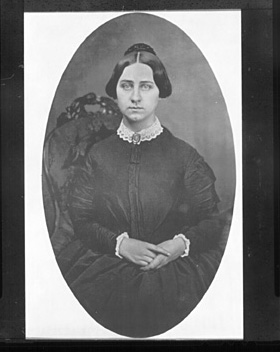
Forgotten Women in Church History: Antoinette Brown

Oberlin College Archives
Antoinette Brown (1825-1921) is best known as the first American woman ordained to the ministry (in 1853).  However, although some mainline Protestant denominations in the United States remember her (the United Church of Christ regularly honors outstanding women in ministry with the Antoinette Brown Awards), as an evangelical Christian I had never heard of her.* After all, churches that are opposed to women pastors are hardly likely to celebrate the first woman who became one!

Her story, though, like those of other women I have commemorated in this "Forgotten Women" series, shows a woman of great intelligence, leadership ability and devotion; and it's hard not to wonder, if God really never intended women to be pastors, why He made a woman like Antoinette Brown.

According to American National Biography Online, Brown was:
born in Henrietta, New York, the daughter of Joseph Brown, a farmer and justice of the peace, and Abigail Morse. Antoinette proved a precocious child, following her older siblings to school at the age of three. The preaching of evangelist Charles Grandison Finney in nearby Rochester during the Second Great Awakening deeply affected the family, and before she reached her ninth birthday, Antoinette Brown joined the Congregational church. The associated reform movements of the era--antislavery, temperance, and moral reform--also drew support from the Browns, who upheld the educational aspirations of both their sons and daughters. Antoinette attended local schools and the Monroe Academy before becoming a teacher in 1841.
Brown then enrolled in the only college at the time which would admit women: Oberlin College in Ohio.  It was there that she met Lucy Stone, the now-famous Abolitionist and Suffragette.  The two women became lifelong friends, and in time, sisters-in-law as well-- each marrying one of the Blackwell brothers whose sisters Elizabeth Blackwell and Emily Blackwell became the first and second woman medical doctors in America.  Brown felt called into ministry and Stone desired a lecturing circuit-- but as women at the time were expected to stay out of the public sphere, the college refused to train them in rhetoric or debate.  Stone and Brown therefore formed their own women's debating society:
The young men had to hold debates as part of their work in rhetoric, and the young women were required to be present, for an hour and a half every week, in order to help form an audience for the boys, but were not allowed to take part. Lucy was intending to lecture and Antoinette [Brown Blackwell] to preach. Both wished for practice in public speaking. They asked Professor Thome, the head of that department, to let them debate. He was a man of liberal views -- a Southerner who had freed his slaves -- and he consented. Tradition says that the debate was exceptionally brilliant. More persons than usual came in to listen, attracted by curiosity. But the Ladies' Board immediately got busy, St. Paul was invoked, and the college authorities forbade any repetition of the experiment. 
A few of the young women, led by Lucy, organized the first debating society ever formed among college girls. At first they held their meetings secretly in the woods, with sentinels on the watch to give warming of intruders. When the weather grew colder, Lucy asked an old colored woman who owned a small house, the mother of one of her colored pupils, to let them have the use of her parlor.
Though Oberlin College was willing to give Brown the kind of education it thought suitable for a woman, its response to her desire to study theology was less accommodating.  As Distinguished Women of Past and Present puts it:
Oberlin was the first coeducational school to grant college degrees to women and to accept students of all races. Women, however, were expected to clean rooms, wash clothes and serve food for the male students. . .  In 1847 Brown finished the literary course taken by most women. She encountered serious objections from the faculty when she then decided to study theology. They did not think it an appropriate field of study for a woman. However, the school charter decreed that no student could be excluded on the basis of sex, so Brown prevailed and finished the theological course in 1850. The Oberlin College faculty, however, refused to award her a college degree and she did not receive a license to preach. The degree was eventually awarded to her twenty-eight years later.
After college Brown began to accept invitations to speak against slavery and on women's rights. Her work in support of women's rights and her attendance at the first National Women's Rights Convention caused her to lose a position she had obtained lecturing to raise funds for charitable work. She then became an independent lecturer, attracting the notice of Horace Greeley, the Abolitionist New York newspaper editor.  He offered to support Brown's preaching ministry in New York City, but instead she accepted an invitation from a Congregational church in rural New York state to become its licensed minister.  She was ordained on September 15, 1853.

Attending the 1853 World's Temperance Convention, Brown became what American National Biography Online calls "the center of controversy" because of being an ordained minister.  She was shouted off the speaking platform by her fellow delegates.  About a year later she cited theological differences with the Congregationalists (mostly over eternal damnation and predestination) and left her pulpit, eventually becoming a Unitarian.

Back in New York City, Brown began ministering in the slums and prisons, contributing pieces to Horace Greeley's New York Tribune on the plight of the poor, and also writing her first book.  In 1856 she married Samuel Blackwell.  While raising five daughters, she continued her writing career, publishing on a variety of different topics, including egalitarian marriage (a very novel concept!).

According to the German website "FemBio":
The couple consciously tried to live out a model of equality within their marriage: “We will be governed very much by circumstances and what seems best as the years go by, but I think, Sam we can be self sovereigns, we can bend everything within and without to our wills, and our wills to our intellects.” A businessman, Samuel shared household chores and childcare, and Antoinette continued to lecture after having given birth to seven children. The couple raised five daughters to adulthood, two of whom became medical doctors, another an artist.
After her husband's death in 1901, Brown returned to ministry, this time as a Unitarian in New Jersey, where she remained until her death at the age of 96.

I believe Antoinette Brown Blackwell should be an inspiration to all women who seek ordination and/or pastoral ministry, or who believe in full equality in Christian marriage.**  Even though 150 years ago it was much harder than it still is today, she showed that a woman in church leadership and in egalitarian marriage could succeed in both her church and her home.

The then-rampant opposition to a woman simply learning theology or speaking in public would be disagreed with now even by most complementarians.  It's important to question whether, if those issues ultimately were judged as being without scriptural support, how much of the opposition to women as pastors or as full partners in their homes, is based on tradition more than on careful reading of scripture.

I might also point out that attempts to prevent  Antoinette Brown from becoming a minister ultimately failed.  The words of Rabbi Gamaliel about the new Christian sect in Acts 5:38-39 should perhaps be taken note of here:
Therefore, in the present case I advise you: Leave these men alone! Let them go! For if their purpose or activity is of human origin, it will fail. But if it is from God, you will not be able to stop these men; you will only find yourselves fighting against God.
Or, in this case, "leave these women alone."   Perhaps its time for the church to stop fighting against women's equality, and leave it in God's hands.

As Gamaliel said, if it is of human origin, it will fail.

But if not. . . .


--------------------
*I never heard of her, that is, until reading Daughters of the Church by Ruth Tucker and Walter Liefeld.  Her story appears on pages 279-281.

**Some might claim that Antoinette Brown Blackwell's move into Unitarianism, reflecting as it does a departure from Christian orthodoxy, disqualifies her as an example for Christian women or as evidence for women's ordination or egalitarian marriage.  However, no one would ever claim that a man becoming a Unitarian proves that men should not be ministers or leaders in their homes.  And in the early 1900s Unitarians were still a Christian sect, if an unorthodox one.  We don't have to agree with everything Brown came to believe, to honor her integrity and her contributions to American religion.  As she herself said“One thing is certain. I am not afraid to act as my conscience dictates, no matter what the world may think ….”

Saturday, August 9, 2014

Forgotten Women in Church History: Amanda Smith

www.wheaton.edu
Amanda Smith (1837-1915) was an African-American evangelist and missionary of remarkable spiritual power, affiliated with the Wesleyan Holiness movement of the late 19th-early 20th centuries, and the African Methodist Episcopal Church.

Amanda Smith's entire autobiography is available online here. She was born in Maryland to slave parents, but her father was enabled by his relatively kind masters to purchase the family's freedom.  Their new home in Pennsylvania became a station on the Underground Railroad.

Amanda's first husband was a Union soldier who was killed in the Civil War.  Her second husband was a deacon through whom she converted to Christianity. Four of her five children died before reaching adulthood; only one daughter, Mazie, survived.

Smith became active in the Holiness movement and followed Phoebe Palmer's doctrine of "entire sanctification," seeking a direct religious experience of God's love and grace.  She received this experience in 1868, accompanied by a beautiful revelation:
And when they sang these words, "Whose blood now cleanseth," O what a wave of glory swept over my soul! . . . I don't know just how I looked, but I felt so wonderfully strange, yet I felt glorious. One of the good official brethren at the door said, as I was passing out, "Well, auntie, how did you like that sermon?" but I could not speak; if I had, I should have shouted, but I simply nodded my head. Just as I put my foot on the top step I seemed to feel a hand, the touch of which I cannot describe. It seemed to press me gently on the top of my head, and I felt something part and roll down and cover me like a great cloak! I felt it distinctly; it was done in a moment, and O what a mighty peace and power took possession of me! I started up Green street. . . .

Somehow I always had a fear of white people—that is, I was not afraid of them in the sense of doing me harm, or anything of that kind— but a kind of fear because they were white, and were there, and I was black and was here! But that morning on Green street, as I stood on my feet trembling, I heard these words distinctly. They seemed to come from the northeast corner of the church, slowly, but clearly: "There is neither Jew nor Greek, there is neither bond nor free, there is neither male nor female, for ye are all one in Christ Jesus." (Galatians 3:28.) I never understood that text before. But now the Holy Ghost had made it clear to me. And as I looked at white people that I had always seemed to be afraid of, now they looked so small. The great mountain had become a mole-hill. "Therefore, if the Son shall make you free, then are you free, indeed."
This brief article summarizes Smith's life after this experience:
Following her second husband's death in 1869, Smith began preaching in churches and at Holiness camp meetings in New York and New Jersey, becoming a popular speaker to both black and white audiences during the 1870s. Although she was not ordained or financially supported by the AME Church or any other organization, she became the first black woman to work as an international evangelist in 1878. She served for twelve years in England, Ireland, Scotland, India, and various African countries. 
In 1892, Amanda Smith returned to the United States and settled in Chicago where she continued preaching. In 1899, Smith opened a home for black orphans, later called the Amanda Smith Industrial School for Girls in Harvey, Illinois. She wrote a monthly newspaper, the Helper, which augmented her fundraising efforts for the school, and published her autobiography in 1893. She retired to Sebring, Florida in 1912, and died in March 1915.
Bishop J. M. Thoburn of India, wrote in his introduction to Amanda Smith's autobiography about his first encounter with her:
Something like a hallowed glow seemed to rest upon the dark face before me, and I felt in a second that she was possessed of a rare degree of spiritual power.  That invisible something which we are accustomed to call power, and which is never possessed by any Christian believer except as one of the fruits of the indwelling Spirit of God, was hers in a marked degree. . . 
Her homely illustrations, her quaint expressions, her warmhearted appeals, all possess the supreme merit of being so many vehicles for conveying the living truths of the Gospel of Jesus Christ to the hearts of those who are fortunate enough to hear her. . . 
The novelty of a colored woman from America, who had in her childhood been a slave, appearing before an audience in Calcutta, was sufficient to attract attention, but this alone would not account for the popularity which she enjoyed throughout her whole stay in our city. 
She was fiercely attacked by narrow minded persons in the daily papers, and elsewhere, but opposition only seemed to add to her power. 
During the seventeen years that I have lived in Calcutta, I have known many famous strangers to visit the city, some of whom attracted large audiences, but I have never known anyone who could draw and hold so large an audience as Mrs. Smith.
Like Jerena Lee before her, Amanda Smith felt the call to preach despite the African Methodist's church's general policy against it.  But she raised the money herself and began her preaching ministry independently, with remarkable results:
There was a large congregation. The gallery was full, and every part of the house was packed. I stood up trembling. The cold chills ran over me. My heart seemed to stand still. Oh, it was a night. But the Lord gave me great liberty in speaking. After I had talked a little while the cold chills stopped, my heart began to beat naturally and all fear was gone, and I seemed to lose sight of everybody and everything but my responsibility to God and my duty to the people. . .

[The next] Thursday night was the regular prayer meeting night. Brother Cooper said I was there, and would preach Thursday night. He was going to give me a chance to preach, and he wanted all the people to come out. . .

The church was packed and crowded. I began my talk from the chapter given, with great trembling. I had gone on but a little ways when I felt the spirit of the Lord come upon me mightily. Oh! how He helped me. My soul was free. . . [W]hen I asked for persons to come to the altar, it was filled in a little while from the gallery and all parts of the house.

A revival broke out, and spread for twenty miles around. Oh! what a time it was. It went from the colored people to the white people. Sometimes we would go into the church at seven o'clock in the evening. I could not preach. The whole lower floor would be covered with seekers— old men, young men, old women, young women, boys and girls. Oh! glory to God! How He put His seal on this first work to encourage my heart and establish my faith, that He indeed had chosen, and ordained and sent me.
Amanda went on to travel as an independent missionary for many years. The Women's Center at Louisville Presbyterian Theological Seminary's article A Method for Empowering Women notes that "Smith’s preaching fueled the holiness revival begun by Palmer." Like Palmer, Amanda Smith was never formally ordained. But she believed that God Himself had ordained her-- and if "ordain" means "make someone a minister," it appears she was right.  In any event, from all appearances the Holy Spirit really didn't care what the church's policies were about women ministering to men, or black people calling for white people's repentance and conversion-- or what anyone thought of Smith's race or sex.

A 1989 Wesleyan Holiness Women Clergy's article Empowered Foremothers speaks of the ministries of women like Phoebe Palmer, Jerena Lee and Amanda Smith:
The authority or command of the Holy Spirit superseded any command by mere man. The Biblical injunction of Acts 5:29 to obey God rather than man became the basis for Wesleyan/Holiness women to challenge the authority of those who attempted to prevent them from preaching. Employing this verse, Palmer explicitly challenged male ecclesiastical authority: "Where church order is at variance with divine order, it were better to obey God than man." . . .

Women asserted their autonomy as they claimed their allegiance to God rather than to men. The belief that women ultimately had to answer to God for their actions opened the way for women to challenge attempts to restrict their religious activities. A comment by the compiler of Phoebe Palmer's letters illustrates the implications of this conviction: "It is always right to obey the Holy Spirit's command, and if that is laid upon a woman to preach the Gospel, then it is right for her to do so. . . .
The Louisville Presbyterian article cited above expands on this by noting how such devotion to God can be empowering to women, particularly when personal religious experience is brought into play:
The opening for women’s leadership and the expression of women’s faith and gifts that Methodism provided arose from a theology that acknowledged the significance of personal experience as one avenue to knowledge of God’s will. By crediting experience, discernment, and a perception of the movement of the Holy Spirit in immediate circumstances, it became possible to weigh this evidence in balance with isolated texts of Scripture that seemed to prohibit women’s preaching or authoritative participation in church life, to come to new conclusions, and to challenge scholastic objections. These women’s practice then further generated persuasive experience of women’s callings in their listeners.
The fact is that the Bible has far more to say to women than the words in a few apparently restrictive texts.  The Bible reflects the callings of many women in texts like Romans 16, 1 Corinthians 1:11 and Philippians 4:2.  The Bible also points beyond itself to the personal empowerment of the Holy Spirit in the lives of all Christ's followers, as demonstrated by the pouring out of the Spirit "on all flesh," male and female alike, in Acts 2.

In Acts 15 the earliest church council yielded to the Holy Spirit's power released on Cornelius's household in Acts 10, as superseding the apparently clear Bible texts requiring circumcision for Gentile converts.  The Spirit's power on Amanda Smith to preach and lead evangelistic church services despite her sex, was apparently just as incontrovertible to most of those who witnessed it in her day.

Smith's final project on returning home from her missionary work, was to establish in 1899 the first orphanage for black children in Illinois, according to this excerpt from Illinois Heritage Magazine 1998:
When Amanda Smith decided to establish the orphanage after finishing her book, it is obvious that she had seen and known the effects of discrimination and was willing to discuss and deal with issues of what we would now call racist practices. Because of her multiple involvements in church and temperance organizations, she was no doubt well aware of both the growing discrimination and segregation in urban areas and also the needs of black children. . . It seemed clear in the face of continuing and growing discrimination that, not only in the South, but throughout the country, the mutual aid tradition within African American communities was necessary in caring for the elderly, the disabled and others in need, including orphans.
 Perhaps in this way Smith was comforted for the four babies she had birthed and lost before they could grow up.  But one thing is clear: she lived the faith she preached, caring for "the least of these" long after her preaching ministry was over.

Amanda Smith's life and ministry is not widely taught in Christian churches today.  Outside the Methodist tradition, I doubt that many Christians have even heard of her.   But her voice speaks to us from 121 years ago, reminding us that religious restrictions on the ministry of women have never been uniformly enforced in Christianity as a whole:
There were then [when she first felt God's call] but few of our ministers that were favorable to women's preaching or taking any part, I mean in a public way; but, thank God, there always were a few men that dared to stand by woman's liberty in this, if God called her. . . but it is different now. We have women deaconesses, and leaders, and women in all departments of church work. May God in mercy save us from the formalism of the day, and bring us back to the old time spirituality and power of the fathers and mothers. I often feel as I look over the past and compare it with the present, to say: "Lord, save, or we perish."
 When it comes to women in ministry, it seems to me that the movement of the Holy Spirit towards freedom and empowerment struggles constantly with traditional forces of restriction and control.  But in the end the Holy Spirit cannot be denied.  So I'll add my voice to Amanda Smith's from 1893, pleading for spirituality and power over formalism and restrictive rules:

"Lord, save, or we perish."

And in the end, save us He will.

Saturday, March 8, 2014

Forgotten Women in Chuch History: The Great Triumvirate - Phoebe Palmer, Catherine Booth and Hannah Whitall Smith

The theme of this year's Women's History Month is "Celebrating Women of Character, Courage and Commitment."  My "Forgotten Women in Church History" series is now up to the mid-1800s, which ushered in the first prominent, public and professional ministries of Protestant women.  Daughters of the Church calls three of these "the great triumvirate" - Phoebe Palmer, Catherine Booth and Hannah Whitall Smith, who all encapsulate this year's theme.

But while the successes of these women were well publicized in their day, Christian history often passes them by.  The book Church History in Plain Language, for instance, has this to say about the founding of the Salvation Army (Third Edition, p. 411):
The most outstanding example of a ministry to the dispossessed was the work of a pietistic evangelical William Booth (1829-1912).  He started the ministry with the Methodist New Connection but soon withdrew to work with London's poor.  His street preaching in London's East End in 1864 met with phenomenal success. . . His workers, organized like a military unit, were soon called the Salvation Army. Evangelist Booth became General Booth.
Catherine Booth has no mention in this book.  And yet the Salvation Army was actually in every way the joint creation of William Booth and his wife, as William Booth himself would have testified! However, Church History in Plain Language not only fails to name her, it also speaks of the Holiness Movement (p. 432) while failing to mention Phoebe Palmer or Hannah Whitall Smith, who were instrumental, if not indispensable, in that movement.

These three women were contemporaries, members of husband-wife teams in which "the women [were] more prominent or equally prominent in each case (Daughters of the Church, p. 261)." All were connected to sectarian movements that "recognized special calls to ministry over and above ordination (Daughters, p. 258)":
The nineteenth century, more than any century before, was one of "women preachers." Most of these women were not ordained, and did not have their own parish, but they nevertheless "preached," attaining wide recognition.  They moved across denominational barriers and sometimes even in circles of high social standing.  This was indeed a new phenomenon in religious life-- one that prompted strong criticism from more traditional elements in the established churches. . . As had been true in previous centuries, the "call" was a very important factor in justifying a woman's role in Christian ministry.
Booth, Palmer and Smith all testified to receiving such a call, and all found well-publicized success in part through the cooperation and support of their husbands, whose own calls to public ministry were of course unquestioned.  In addition, each of these women introduced her own new contribution to the particular doctrinal emphasis of the movement with which she was associated.


Phoebe Palmer

According to ChristianHistory.Net, Phoebe Palmer was
one of those cases of someone almost unknown today, who actually left a Rushmore-sized impression on America's religious landscape.  Phoebe Palmer was the most influential woman in the largest, fastest-growing religious group in mid-19th-century America—Methodism. By her initiative, missions were begun, camp-meetings instituted, and many thousands attested to the transforming power of divine grace. She mothered a nationwide movement that birthed such denominations as the Church of the Nazarene and the Salvation Army, bridged 18th-century Methodist revivalism to 20th-century Pentecostalism, and pioneered in social reform and female ministry. . . [T]his included ministering to Methodist bishops in her parlor, launching benevolent missions in the worst slums of New York, mobilizing an army of lay evangelists, writing impassioned biblical arguments for women in ministry, and preaching on two continents. And as she did these things, she helped launch a revival that changed a nation.
Palmer began holding informal prayer meetings called "Tuesday Meetings for the Promotion of Holiness" in the 1830s.  This inspired other women to begin the same type of meetings, which "sprang up all over the country" and "had a significant influence also outside Methodist circles, particularly among Congregationalists, Episcopalians, Baptists and Quakers (Daughters, p. 261-262)."   Palmer's "crowning achievement" was the Five Points Mission, which housed and provided schooling, both secular and religious, to about twenty poor families in New York.

In the fall of 1857 Palmer and her husband Walter spoke in Ontario, Canada, attracting large crowds, and a religious renewal sprang up which quickly spread back to America and then to England.  "At the time of her death, she was credited with having brought some 25,000 people to Christ for salvation (Daughters, p. 263)."

But the main emphasis of Palmer's teachings was her view of the Wesleyan doctrine of "entire sanctification."  John Wesley had believed that a disciplined life could lead eventually to an attainment of "perfect love" in Christ during life on this earth.  Palmer, however, was "proposing a radically new concept" -- that this blessing was "available the moment a Christian consecrated everything to God" and that "all an individual needed to do was to become a 'living sacrifice on the altar of Jesus Christ.'" Though this teaching was controversial, its emphasis on a grace-filled encounter with Christ as a "second blessing" for Christians drew many into a closer relationship with God.

A detailed survey of the life and ministry of Phoebe Palmer can also be found on Marg Mowczko's New Life blog.


Catherine Booth

Catherine Booth's husband William Booth was a prominent Methodist preacher in England.  Criticism of Phoebe Palmer's right to preach led Catherine to write a pamphlet entitled Female Ministry: Or, a Woman's Right to Preach the Gospel in 1859.  ChristianHistory.Net summarizes the pamphlet as follows:
[It was] a short, powerful defense of American Phoebe Palmer's holiness ministry. It was not a plea based on natural rights or other feminist themes of the day. Instead, she founded her argument on the absolute equality of men and women before God. She acknowledged that the Fall had put women into subjection, as a consequence of sin, but to leave them there, she said, was to reject the good news of the gospel, which proclaimed that the grace of Christ had restored what sin had taken away. Now all men and women were one in Christ. 
In responding to her critics, she asked, "If the Word of God forbids female ministry, we would ask how it happens that so many of the most devoted handmaidens of the Lord have felt constrained by the Holy Ghost to exercise it? … The Word and the Spirit cannot contradict each other."
ChristianHistory.Net adds, "When she shared her emerging convictions with her new husband, he said, 'I would not stop a woman preaching on any account.' But he added that neither would he 'encourage one to begin.'"

Encouraged or not, it was about a year later that Catherine felt an inner prompting to rise after one of William's Sunday morning sermons and begin to speak.  Daughters of the Church says that "William was as surprised as anyone when she made her sudden announcement, but he quickly recovered, and when she had finished, he announced that she would preach that evening." (p. 264)

When, shortly afterwards, William became ill, Catherine found herself taking over his entire preaching circuit.  When he recovered, they left the Methodists to start their own revivalist ministry in London.  Catherine began preaching in the wealthy West End, while William began his very successful ministry to the poor in the East End.  But she soon joined him in city mission work, taking on a special ministry of rescuing women from prostitution.  Out of this joining of forces, the Salvation Army came into being-- and right from the start it encouraged the full involvement of women in ministry, and about half its ministers in the field were women.

The Booths then decided to spread the movement to America, sending a special team of women known as "The Splendid Seven" to preach the gospel and establish ministry to the poor.  The Army was widely scorned by "virtually every sector of society," and many Army workers, men and women alike, were often victims of assault (Daughters, p. 267). But the Booths persevered, and their children took up the banner of service after them-- most notably Evangeline Booth, who began preaching at the age of 15 and eventually became General of the worldwide movement.

Catherine Booth's special contribution to the doctrines of her movement was that whereas Phoebe Palmer had seen herself as an exception to women's usual domestic role, Booth insisted on the full equality and full contribution of women in ministry and in marriage.  Indeed, in her preaching ability she surpassed the men of her day, as Norman Murdoch wrote:
Many agree, no man of her era exceeded her in popularity or spiritual results, including her own husband. (from Church History magazine, September 1984; quoted in Daughters of the Church, p. 267.)

Hannah Whitall Smith

Hannah Whitall Smith was raised Quaker and is best known for her devotional book The Christian's Secret of a Happy Life.  She was married to Quaker minister Robert Pearsall Smith, and according to ChristianHistory.Net:
The two Smiths inspired the British Keswick movement, a non-Wesleyan holiness stream that would become highly influential back in America. Hannah was the more theologically astute as well as the more personally stable of the two, and her public appearances were noted for their quiet logic and their lack of the emotional appeals that Victorians associated with "feminine" rhetoric. It was Robert who experienced a "magnetic thrill of heavenly delight" in his 1867 "second blessing" experience, while Hannah's holiness teaching emphasized the subordinate role of feelings.
Hannah emphasized surrender and total abandonment to God:  "In order for a lump of clay to be made into a beautiful vessel, it must be entirely abandoned to the potter, and must lie passive in his hands."  In the 1870's she and her husband conducted a series of meetings in England in which she was hailed as "the angel of the churches (Daughters, p. 268)." Though their ministry eventually ended in a scandal caused by Robert's misconduct with a young woman, Hannah Whitall Smith continued to make public appearances from time to time, including a promotion of women preachers in London in 1895.

ChristianHistory.Net goes on to speak of the "Keswick" group that arose out of Hannah's "Deeper Life Movement":
The legacy of the Smiths lived on. . . in the English "Keswick" conferences, which began in the 1870s and continue today. Keswick participants—a denominationally mixed but predominantly Anglican group—preferred Boardman's term "the higher Christian life" to the more radical Wesleyan language of "entire sanctification" or "perfection." They denied that sinful tendencies could be eradicated (as many American Methodists believed). Instead, they taught that sin was counteracted by the experience of "baptism with the Spirit," allowing for a joyful and victorious Christian life.
Out of this movement came the ministry of Dwight L. Moody, and it also led eventually to the rise of the Pentecostal and Charismatic movements.

Conclusion

All three of these women profoundly influenced Protestant Christianity as we know it today.  As ChristianHistory.Net puts it:
Throughout Christian history, from the martyrs and monastics to the Puritans and Pietists, movements have arisen in pursuit of a deeper devotion and more active Christlikeness.
Palmer, Booth and Smith took up just such a pursuit, and the movements that they helped engender are still bearing fruit today. In fact, the holiness movement was largely dependent on the contributions of these women and others like them, and it's impossible to fully account for this major movement and its descendant movements in Christian history, without the actions of women.

Even though we may not agree with everything they taught (nor did they always agree with each other), Palmer, Booth and Smith did agree on the beauty and holiness of Christ and our need to connect with Him as branches do to the vine (John 15:5).  As women of character, courage and commitment whose legacy lives beyond them, this "great triumvirate" of mid-19th-century women preachers should not be forgotten.

Saturday, November 16, 2013

Forgotten Women in Church History: Jerena Lee (1783-1860?)

Jerena Lee was the first female African-American preacher and evangelist in the United States.  Born in New Jersey in 1783 to free but poor black parents, she traveled in her lifetime over 2300 miles and preached nearly 200 sermons to gatherings of men and women, blacks and whites.  Everywhere she went the power of her preaching overcame the considerable prejudices of her era against both her sex and her race.

Most people today have never heard of her.

Though not a slave, Jerena Lee was separated from her parents at the tender age of seven, becoming a live-in maid for a white family.  She didn't see her own family again until she was 21.  In her early 20s she was converted to Christianity through the preaching of Richard Allen, founder of the African Methodist Episcopal Church.  When she was 28 she married a black preacher, Joseph Lee, who died only a few years later, leaving her to raise two small children on her own.

According to the pamphlet form of her autobiography, which is available online, Ms. Lee experienced a "call to preach the gospel" several years after she had become a Christian, but before her marriage.  She described it like this:
[O]n a certain time, an impressive silence fell upon me, and I stood as if some one was about to speak to me, yet I had no such thought in my heart. - But to my utter surprise there seemed to sound a voice which I thought I distinctly heard, and most certainly understand, which said to me, "Go preach the Gospel!" I immediately replied aloud, "No one will believe me." Again I listened, and again the same voice seemed to say - "Preach the Gospel; I will put words in your mouth, and you will turn your enemies to become your freinds." [sic] 
At first I supposed that Satan had spoken to me, for I had read that he could transform himself into an angel of light for the purpose of deception. Immediately I went into a secret place, and called upon the Lord to know if he had called me to preach, and whether I was deceived or not; when there appeared to my view the form and figure of a pulpit, with a Bible lying thereon, the back of which was presented to me as plainly as if it had been a literal fact.
When Ms. Lee told her pastor, Richard Allen, that she felt called to preach, he responded that "our Discipline knew nothing at all about it-- it did not call for women preachers."  Jerena Lee felt a certain relief, but she also "found that a love of souls had in a measure departed from me; that holy energy which burned within me, as a fire, began to be smothered."

Nevertheless, Lee submitted to Rev. Allen and did not try again to preach.  Instead she married, birthed two children, and was widowed.  Eight years after her initial call, she was in church listening to the minister (Rev. Allen, by then a bishop, was also present) when the call came again:
But as [the minister] proceeded to explain [give the sermon], he seemed to have lost the spirit; when in the same instant, I sprang, as by altogether supernatural impulse, to my feet, when I was aided from above to give an exhortation on the very text which my brother Williams had taken. 
I told them I was like Jonah; for it had been then nearly eight years since the Lord had called me to preach his gospel to the fallen sons and daughters of Adam's race, but that I had lingered like him, and delayed to go at the bidding of the Lord, and warn those who are as deeply guilty as were the people of Nineveh. 
During the exhortation, God made manifest his power in a manner sufficient to show the world that I was called to labour according to my ability, and the grace given unto me, in the vineyard of the good husbandman. 
I now sat down, scarcely knowing what I had done, being frightened. I imagined, that for this indecorum, as I feared it might be called, I should be expelled from the church. But instead of this, the Bishop rose up in the assembly, and related that I had called upon him eight years before, asking to be permitted to preach, and that he had put me off; but that he now as much believed that I was called to that work, as any of the preachers present. These remarks greatly strengthened me, so that my fears of having given an offence, and made myself liable as an offender, subsided, giving place to a sweet serenity, a holy joy of a peculiar kind, untasted in my bosom until then.
Leaving her children in the care of her mother and other family members, Ms. Lee began to travel and preach, even going into slaveholding states, where many slaves walked miles to hear her and then walked all night afterwards to return to their plantations before being missed.  Consulting no man and guided only through prayer and the invitations she received, she preached her way across the United States and Canada. Prejudice and resistance to her preaching was overcome by the power of the Holy Spirit over and over again throughout Jerena Lee's preaching career.  Here is one representative example:
L. W., a respectable brother from Chillicothe, had never heard a woman preach, and was much opposed to it. An appointment was given me, and when I went into the desk and commenced reading the hymn to commence the worship, he looked at me a while, then got up and went out and stood until I had nearly got through the hymn, and then he came in, when I asked him to pray for us but he refused. I prayed myself, after which I took my text, and felt much liberty in speaking in the spirit indeed. And after meeting he came and shook hands with me in the spirit of a Christian, and next day he came and confessed to me his prejudices had been so great, so much like his father, that he could not unite with me, but now he believed that God, was no respecter of persons, and that a woman as well as a man, when called of God, had a right to preach. He afterwards became a licensed preacher, and we parted in peace.
Lee's autobiography also details her arguments justifying her calling:
O how careful ought we to be, lest through our by-laws of church government and discipline, we bring into disrepute even the word of life. For as unseemly as it may appear now-a-days for a woman to preach, it should be remembered that nothing is impossible with God. And why should it be thought impossible, heterodox, or improper for a woman to preach? seeing the Saviour died for the woman as well as for the man. 
If the man may preach, because the Saviour died for him, why not the woman? seeing he died for her also. Is he not a whole Saviour, instead of a half one? as those who hold it wrong for a woman to preach, would seem to make it appear. 
Did not Mary first preach the risen Saviour, and is not the doctrine of the resurrection the very climax of Christianity - hangs not all our hope on this, as argued by St Paul? Then did not Mary, a woman, preach the gospel? for she preached the resurrection of the crucified son of God. . .
If then, to preach the gospel, by the gift of heaven, comes by inspiration solely, is God straitened: must he take the man exclusively? May he not, did he not, and can he not inspire a female to preach the simple story of the birth, life, death, and resurrection of our Lord, and accompany it too with power to the sinner's heart. As for me, I am fully persuaded that the Lord called me to labor according to what I have received, in his vineyard. If he has not, how could he consistently hear testimony in favor of my poor labors, in awakening and converting sinners?
Jerena Lee disappeared from public life at the age of 66, having ended her preaching career and completed and published her autobiography.  The date and place of her death are unknown.  But I can't help thinking of Acts 10:9-48, where Peter was shown in a vision that his understanding of God's work had been too limited, and that he must not call the Gentiles unclean or refuse to associate with them, for God's Spirit could fall on them as well as on Jews.  Peter had to let the evidence of the power of the Spirit overcome his understanding of the "biblical" way he thought things were supposed to work.  He couldn't deny that despite what looked like the "plain meaning" of the Scriptures that only Jews could be God's people, the Spirit of God had fallen on a bunch of uncircumcised Gentiles.

I remember a former pastor of mine once saying something similar after visiting China in the early 1990s. When he had seen the congregations and heard the preaching of several different young women (all of whom said they were called into ministry, and through whom many people's lives had been changed), my pastor said, "Who was I to argue with God?  I could no more deny the truth of their callings than I could deny the truth of my own."

In a time and place bent more strongly against her than is even conceivable today-- a time and place where black people were considered inferior, and black women even more so-- Jerena Lee walked in power from the Holy Spirit that could not be repudiated.  To Christians and non-Christians, leaders and laypeople, white and non-white, men and women, free people and slaves, she spoke with authority the call to repent, believe, and live a holy life. As she wrote:
[B]y the instrumentality of a poor coloured woman, the Lord poured forth his spirit among the people. Though, as I was told, there were lawyers, doctors, and magistrates present, to hear me speak. . . the Lord scattered fire among them of his own kindling. The Lord gave his hand-maiden power to speak for his great name, for he arrested the hearts of the people, and caused a shaking amongst the multitude, for God was in the midst.
The only way around it is to forget it ever happened.  And we've done a pretty good job of that.

But the time has come to remember Jerena Lee.

I'm not saying Ms. Lee was perfect.  I'm not saying she was right in every doctrine or that she never acted unspiritually.  But I am saying God chose her-- and He never lets imperfections bother Him when He chooses a man, so why should imperfections disqualify a woman?

But if the Bible is really "clear" that God forbids all women everywhere to ever teach or exercise authority over men, then when God chose Jerena Lee and sent her out on her own, without even a "male covering," He acted in contradiction of His own word.

Either that, or a "poor coloured woman" who loved God with all her heart, brought people to Christ by some unholy power.  But didn't Jesus have something serious to say to those who believed the same thing of Him?  Matthew 12:26-28.

What if God actually acted exactly in keeping with His own word?  "God chose things the world considers foolish in order to shame those who think they are wise. And he chose things that are powerless to shame those who are powerful." (1 Corinthians 1:27, NLT version)

Maybe what's really clear is that church hierarchies and the gatekeepers of doctrine sometimes think they're wise when they're not, and hold onto power when they shouldn't.  Maybe God can and does do things that just don't fit into restricting, limiting "biblical" boxes, and when we read the Bible that way, we're doing Him and ourselves a disservice.

Let's let the witness of Jerena Lee speak to us once again.  The gifts and callings of God are for all.

----------------------------

Resources:

Pamphlet version of Lee's Religious Experience and Journal, published online

University of Minnesota's Voices from the Gaps

PBS's Africans in America Resource Bank

PBS's God in America

Susan Ditmire's History of Cape May County, New Jersey

Daughters of the Church by Ruth Tucker and Walter Liefeld, pp. 259-60.


Saturday, July 27, 2013

Susanna Wesley - Forgotten Woman in Church History?

Susanna Wesley, the mother of John Wesley (the founder of Methodism) and of his hymn-writing brother Charles, isn't exactly a forgotten woman in church history.  In the evangelical circles in which I spent my formative Christian years, she was one of the only historical Christian women who was mentioned in teachings and sermons -- usually by women leaders of other Christian women, who held up Susanna Wesley as the superlative example of what it meant to be a good Christian woman: wife of a church leader, mother of many, and devoted to God.

Susanna Wesley, I was taught, was a gracious and submissive minister's wife who had 19 children and raised 10 of them to pious adulthood through her strict but loving parenting.  Susanna devoted one hour a week per child to one-on-one spiritual counseling, but when she sat in her kitchen and pulled her apron over her head, all her children knew she was in prayer and that punishment for interrupting her unless in dire emergency would be severe.  Susanna was the Christian woman we all should take as our example and strive to emulate.  Susanna was proof that it was possible to be a good mother to so many children, and we all should desire to have as many children as we felt in our hearts God wanted us to have. (Maranatha Campus Ministries, where I was taught these things, was pre-Quiverfull and officially rejected the anti-birth control message just beginning to be spread by Mary Pride-- but Maranatha women still learned that the highest honor they could attain was to be a pastor or missionary's wife -- and thus automatically a leader of women's ministry-- and a mother of many).

What my Maranatha teachers apparently didn't know was that in Susanna Wesley's time, being a minister's wife did not put you in charge of women's ministry.  Women were forbidden to minister at all-- not even to other women.  But even so, what was most emphasized in their teachings about Mrs. Wesley was that motherhood itself was the most important thing for a woman.  And if you were as good and godly a mother as she was, you might even raise a John Wesley!

The biographies of Susanna Wesley I have found online also tend to emphasize her motherhood of the famous Wesley brothers, almost to the exclusion of everything else.  Susan Pellowe's blog, for instance, opens with this:

Susanna Wesley (1669-1742), although she never preached a sermon or published a book or founded a church, is known as the Mother of Methodism. Why? Because two of her sons, John Wesley and Charles Wesley, as children consciously or unconsciously will, applied the example and teachings and circumstances of their home life.

I would be the last to say this isn't an amazing accomplishment.  Raising children who contribute to the good of the world is a very meaningful thing-- whether we're mothers or fathers.  But the above blog is incorrect about Susanna Wesley having never preached a sermon; she actually preached hundreds of sermons, to men, women and children alike, during the absences of her husband, Samuel Wesley, from his Anglican parish.  According to Daughters of the Church: Women in Ministry from New Testament Times to the Present by Ruth Tucker and Walter Liefeld, John Wesley himself is quoted as calling his mother a "preacher of righteousness."  (p. 237)

The way it came about was this.  Samuel Wesley was apparently an autocratic and intolerant minister and a strict disciplinarian of his flock, resulting in his widespread unpopularity in his own parish.  In fact, he was often harassed by his parishioners, and there were many times when he was away from the parish (Ibid, p. 236).  During the winter of 1711-12, Samuel was away for an extended period, and Susanna began holding meetings in her home.  The History's Women website details the situation:

Samuel was attending a long church conference leaving his pulpit in charge of another minister, a Mr. Inman. . . .Since there were no afternoon church services, Susanna began an evening family gathering where they sang psalms, prayed and Susanna read a short sermon from her husband’s library. It began with the family and the servants but soon word spread and others neighbors appeared, and soon there were too many for the parsonage. Susanna had written her husband of what she was doing, but then in his own letter when he perhaps saw the services as competition, Mr. Inman complained to Samuel. . . [because] at that time the idea of a woman having any part in a worship service – even in her own home – was unheard of.   Samuel suggested to Susanna that she have someone else read the sermons, but still Mr. Inman complained and finally Samuel told Susanna to discontinue the meetings. However, she declined as she described how the meetings were a genuine and effective ministry to those who attended and that Mr. Inman was about the only one who‘d objected. The services continued.

Daughters of the Church, describing these meetings, says that "Susanna could not prevent the spontaneous growth. . . to the point where she could say: 'Last Sunday I believe we had above two hundred.  And yet many went away, for want of room to stand.'" (p. 238)

The people of the Wesley parish strongly preferred Susanna's sermons to those of either Samuel Wesley or his chosen replacement.  They could have simply attended morning services and considered their spiritual duty done-- but what Mrs. Wesley was offering was clearly something that spoke to their hearts and met their spiritual needs.  They came because they wanted to come.  As this series on women in church history has already frequently illustrated, the Holy Spirit has often found cracks in the systemic repression of women's ministry, through which to speak through God's daughters-- despite the best efforts of their brothers in the faith.  

And despite the emphasis of my teachers on Mrs. Wesley as a submissive wife, Susanna was not particularly submissive-- even despite the fact that the law of the time required women to be obedient to their husbands.  History's Women explains:

Susanna was a strong supporter of the Stuart King James who had been overthrown in 1688 and replaced by William, his Dutch son-in-law. In 1702 when in family prayers Samuel prayed for King William Susanna refused to say “Amen.” She was, as her son John described it later, “inflexible”, and Samuel was equally so.

“Sukey,” he told her as he left home. “We must part for if we have two kings we must have two beds.” Susanna asserted that she would apologize if she was wrong but she felt to do so for expediency only would be a lie and thus a sin.

In her own writings (quoted in Daughter of the Church, p. 237), Susanna Wesley said that after calling her into his study, her husband "imprecated the divine vengeance on himself and all his posterity if ever he touched me more or came into a bed with me before I had begged God's pardon and his, for not saying amen to the prayer for the King. . . I have unsuccessfully represented to him the unlawfulness and unreasonableness of his Oath [referring to 1 Cor. 7:5's admonition that husbands and wives should not "deprive one another" except for short periods of prayer] . . . that since I am willing to let him quietly enjoy his opinions, he ought not to deprive me of my little liberty of conscience."  

More than a year later, after the death of the king whose rule had caused the conflict, Samuel returned to Susanna and to her bed, and it was shortly after this that John Wesley was conceived.  Susanna had proved herself right about her husband's foolish oath.  Nor did she afterwards refrain from expressing her differences of opinion from her husband, but had no difficulties telling John when she thought her advice for his future was better than the advice of his father. (Ibid)

Mrs. Wesley was not, however, unmindful of the English laws requiring her obedience.  The United Methodist Women website notes that when Samuel Wesley asked Susanna to discontinue her unauthorized meetings, this was how she worded her dissent:

"If after all this you think fit to dissolve this assembly do not tell me you desire me to do it, for that will not satisfy my conscience; but send your positive command in such full and express terms as may absolve me from all guilt and punishment for neglecting this opportunity for doing good when you and I shall appear before the great and awful tribunal of our Lord Jesus Christ.

The wisdom and intelligence of this answer is admirable.  In effect, Mrs. Wesley placed on her husband the responsibility before God of stopping what she believed, and desired Samuel to believe, was God's own work.  Her words had the effect she apparently intended, because Samuel never issued that command. 

Susan Pellowe (see above) also notes:

Susanna Wesley wrote meditations and scriptural commentaries for her own use. She wrote extended commentaries for instance on the Apostles Creed, the Lord's Prayer, the Ten Commandments. Alas many of these were lost in the rectory fire, but many survive. The most accessible means to her writings is Charles Wallace's excellent and important Susanna Wesley, Her Collected Writings.

Those surviving writings reveal her as "a practical theologian in her own right. . . in conversation with contemporary theological, philosophical, and literary works," according to Google Books.

With such a mother as this, John Wesley could hardly help being open to God calling women in his own movement into full public ministry, even though he was initially against it.  As Daughters of the Church puts it (p. 242), "Wesley eventually became so convinced of the rightness of women's ministry that he openly encouraged women to preach, despite the opposition he knew they would face.  [Methodist preacher] Sarah Mallet recalled that he had advised her 'to let the voice of the people be to me the voice of God; -- and where I was sent for, to go, for the Lord had called me thither.'"

Susanna Wesley had influence on her son John, all right-- but in evangelicalism, this particular result of her influence is somehow never brought up.

In light of all this, the cherry-picking of Susanna Wesley's life story, such that she is only known as a minister's wife and mother of the founders of Methodism, seems profoundly unfair.  Why are women so often defined only in terms of the men in their lives?  The Christianity.com website thoroughly illustrates this in its entry about her, which is entitled "Susanna Wesley, Christian Mother" and mentions none of her other accomplishments.

Susanna Wesley may not be a forgotten woman in church history-- but the whole Susanna Wesley-- the complete person and all her accomplishments-- certainly is.  If evangelical Christianity is going to hold a woman up to us as a historical example for Christian women everywhere, we Christian women should be given the whole picture, not just what Christian leaders want us to hear in order to keep us compliantly in our place.  Susanna Wesley is not just an example of a godly mother-- though of course she is that.  But she is also an inspiration to women everywhere to do the utmost with what they are given with their whole selves, remembering that:

". . . religion is not to be confined to the church... nor exercised only in prayer and meditation, but that every where I am in Thy Presence." 

Amen, Susanna Wesley. Amen. 

Friday, February 1, 2013

Forgotten Women in Church History: Margaret Fell (1614-1702)

Margaret Fell is often called "the mother of Quakerism," and as such, she has not been forgotten by the Society of Friends.  As this site (run by her descendants) notes:

Most historians credit George Fox with founding Quakerism but it was Margaret who contributed her fortune and administered the finances of the young church, publicly defended the religion, visited meetings and took care of correspondence.  In addition to being a missionary, preacher, and teacher, Margaret wrote at least 16 books and 27 pamphlets discussing and defending her religion.

In spite of this, the Answers.com entry on the history of Quakerism doesn't mention Margaret Fell at all (though it does give her an entry in "Women of World History").  Neither does the online Encyclopedia Britannica's Quakerism entry.  And this historical overview of Quakerism from Ex Libris gives her only a passing mention, and then only in terms of being first the wife of Judge Fell (who actually never became a Quaker himself but is valued instead for the protection his influence gave the Quaker movement) and then later as George Fox's wife.  Margaret Fell's own theological and practical  leadership at the time when Quakerism was defining itself (and in many ways being defined by her teachings) is often downplayed or ignored.

Margaret Fell was born in 1614 in Lancashire, England.  In 1632 she married gentleman Thomas Fell, owner of Swarthmoor Hall, who became a justice of the peace for Lancashire and later a circuit-traveling judge of the court of assizes.  In 1652, while her husband was away on circuit, Lancashire was visited by George Fox, who was then near the beginning of his ministry.  Margaret and her children were convinced by his teachings, and when Judge Fell returned home, he was greeted by neighbors warning him that his family had converted to Fox's version of Christianity.  Judge Fell met with Fox himself and, though never fully embracing the Quaker way, was supportive of his wife's religious views and allowed Swarthmoor Hall to become a meeting place for the movement.

When Judge Fell died in 1658, Margaret inherited Swarthmoor Hall but lost the protection of the Judge's power and influence.  The Quakers meeting in her home began to suffer persecution, and George Fox was arrested and thrown in prison for treason in 1659.  Margaret left Swarthmoor to visit the King of England, securing Fox's release and obtaining a proclamation of freedom for Quakers.  Nevertheless, Parliament enacted a law stating that people who refused to take an oath of loyalty to the crown could be imprisoned.  This law was aimed at Quakers, who believed that taking oaths of any kind was against the teachings of Christ.  Margaret, however, publicly clarified that this belief was in no way an expression of disloyalty.  As Stanford Encyclopedia of Philosophy states:

[Margaret Fell] was. . . one of the first writers to articulate the Quaker philosophy of peace and non-resistance. In a letter to Charles II, dated 1660, she declares that the Quakers aspire

"to live peaceably with all men, And not to Act any thing against the King nor the peace of the Nation, by any plotts, contrivances, insurrections, or carnall weapons to hurt or destroy either him or the Nation thereby, but to be obedient unto all just & lawfull Commands." (Glines 2003, 280)

Fell emphasizes that although Friends cannot in good conscience take an oath, “in Substance they perform that, which is true Allegiance to the King” (Fell 1710, 29–30).


In 1664 Margaret herself was imprisoned for refusing to take an oath of loyalty, and remained in prison for over four years, during which time she wrote many of her pamphlets and longer works.  In 1668 the king granted her release, even though her estate was forfeited to her son George Fell, who was not a Quaker.  He however, allowed his sisters (who were Quakers) to occupy Swarthmoor Hall, and Quaker meetings continued to be held there. In 1669 Margaret married George Fox, and together they continued building the Society of Friends.  Both spent additional time in prison for their beliefs (though not together), and were also separated from time to time by missionary journeys, but they dedicated the rest of their to the teaching of "Inner Light" from the Holy Spirit.

In 1686 the Act of Toleration signed by James II finally freed Quakers from imprisonment and persecution, and George and Margaret Fox were able to build a meeting house on the Swarthmoor property.  George Fox died in 1691, and Margaret in 1702.  Her last words were "I am at peace." 

The Stanford Encyclopedia summarizes Margaret Fell's life as follows:

Together with Fox and William Penn, Fell is now regarded as one of the founders of Quakerism. She helped to sustain the movement through her large correspondence with other Friends on a range of personal and religio-political topics. She travelled widely and spent extended periods in London petitioning the political authorities on behalf of persecuted Quakers (she personally addressed not only Oliver Cromwell but also Charles II and James II). And on at least three occasions, she spent periods in prison for holding Quaker meetings at her house and for refusing to take the Oath of Allegiance. Together [she and George Fox] were active organizers of the separate Quaker women's meetings, first officially begun in 1671. . . She was the author (or co-author) of at least 23 works in total, mostly in the form of short pamphlets.


 According to Daughters of the Church by Tucker and Liefeld:

The most enduring legacy that Fell left to the Quakers was her writing.  She was an outstanding apologist for the movement during the early years, and her policy positions became an integral part of Quaker belief.  In 1660, she wrote a "Declaration and an Information" that officially set forth the Quaker position on pacifism.  She also responded in print to critics of Quakerism, seeking to show that the movement was not a bizarre or seditious sect. . . p.230

Tucker and Liefeld also note the enduring legacy of Fell's work to advance the equality of women in ministry:

The writing that is most often associated with her is Women's Speaking Justified by the Scriptures, first published in 1666.  Here again her influence on Quaker belief was enormous.  Fox himself had written against restricting women in ministry a decade earlier, but "he had not fully developed the argument in favor of women preaching; that remained for Margaret Fell to do."
p. 230, quoting in part the Introduction to Women's Speaking Justified.

The website of the Tokyo Branch of the Society of Friends  describes this work as "a quite vigorous defense of women's spiritual equality and justifies women being active in the public ministry. It remains an important work today, when numerous churches continue to restrict the ministry of women. It is a very careful exegesis of scripture, highlighting the difference between women under the Law and women of the New Creation under Christ. Fell is a particularly appropriate person to write this tract, as her life and ministry ably demonstrates how powerfully the Lord can work in public ministry through a woman."

I can think of no better conclusion than to quote from it.

Mark this, you that despise and oppose the Message of the Lord God that he sends by Women; What had become of the Redemption of the whole Body of Mankind, if they had not cause to believe the Message that the Lord Jesus sent by these Women, of and concerning his Resurrection? And if these Women had not thus, out of their Tenderness, and Bowels of Love, who had received Mercy, and Grace, and Forgiveness of Sins, and Vertue, and Healing from him; which many Men also had received the like, if their Hearts had not been so united and knit unto him in Love, that they could not depart as the Men did; but sat watching, and waiting, and weeping about the Sepulchre until the time of his Resurrection, and so were ready to carry his Message, as is manifested, else how should his Disciples have known, who were not there?

Oh! Blessed and Glorified be the Glorious Lord; for this may all the whole Body of Mankind say, though the Wisdom of Man that never knew God, is always ready to except against the Weak; but the Weakness of God is stronger than Men, and the Foolishness of God is wiser than Men, 1 Cor. 1 25.

Friday, March 23, 2012

Forgotten Women in Church History: Teresa of Avila (1515-82)

Teresa of Avila shares with Catherine of Siena the honor of being the first women named Doctors of the Church by the Catholic Church in 1970. This is a title given by the Catholic Church to persons whose writings are deemed in accordance with Catholic doctrine and appropriate for teaching. Teresa was born in Spain two years before the Protestant Reformation began. She was a Carmelite nun who dedicated herself to reforming that Order, and she founded many Carmelite convents throughout Spain. Thus she is considered a figure of the Catholic Reformation, which was a movement for spiritual renewal and against corruption within the Roman Church, by those who did not wish to abandon it as the Protestants were doing. She was canonized shortly after her death, and thus joins St. Lioba and St. Catherine as women the Catholic Church remembers, but who are still forgotten by many modern Protestants.

It is interesting that a papal official investigating St. Teresa’s activities once described her as “a restless gadabout, disobedient, contumacious woman who. . . is ambitious and teaches theology as if she were a doctor of the Church in spite of St. Paul’s prohibition.”

Teresa, however, summarized her own work as follows:

Since I was only a woman, and a base one at that. . . I resolved to do the little that was in me: namely, to follow the evangelical precepts as fully as I could, and endeavor that those nuns who were with me should do likewise, dedicating ourselves to prayer for the preachers and learned men who are defending the church.

Most of Teresa’s writings, which are now viewed as good for teaching by the Church, she wrote not because she was "ambitious," but because she was directed to by her superiors, in order to prove that she was not a heretic. But St. Teresa really is now a Doctor of the Church, a fact which might now cause her to smile at the papal official's words, which certainly would have wounded her at the time— for she was a loyal and devoted Catholic despite the suspicion and opposition she received.  The endurance of her words, when the words against her have long since faded away, I believe shows the hand of divine Providence in lifting up His daughters in spite of what humans have thought Paul was prohibiting.

Teresa was a warm and outgoing person who made friends easily. She was also deeply religious even as a young child, and felt a conflict within herself between the two in her teen years, as she considered whether to marry or take the veil. She endured periods of serious illness and pain, including a bout with malaria that left her paralyzed in the legs for three years (the healing of which was considered a miracle). But she found consolation in prayer, and after a heartfelt experience of the grace and forgiveness of God while reading Augustine's Confessions, she began to experience the presence of God in visions and what she called “raptures." Her famous written work Interior Castle is a spiritual guide to union with God through seven stages of prayer. The Christian Classics Ethereal Library has called this work “a spiritually challenging book” containing “much literary merit as a piece of Spanish Renaissance literature. . . on a par with other great works of [its] time.”

Her other writings, including her autobiography, focus  primarily on prayer and contemplation. However, she also insisted on practical service, writing:

Let everyone understand that real love of God does not consist in tear-shedding, nor in that sweetness and tenderness for which we usually long, just because they console us, but in serving God in justice, fortitude of soul and humility.

But St. Teresa is perhaps best known for the establishment of Carmelite houses: sixteen or seventeen in all. She wrote The Way of Perfection to teach the nuns in her houses to live in greater holiness and devotion to Christ. Many church authorities were threatened by her efforts at reform-- and she had the misfortune of ministering during the heyday of the Spanish Inquisition. When her close associate, St. John of the Cross, was imprisoned, Teresa went into hiding. But in the end the pope ruled in her favor by permitting her reformed convents to continue functioning.

Teresa of Avila was a wise, personable and very influential leader and reformer. As Biographies Online puts it:

She had an endearing, natural quality; her life energy attracted and inspired many who were close. They admired her for both her outer charm and inner serenity. . . She guided the nuns not just through strict disciplines, but also through the power of love, and common sense. Her way was not the way of rigid asceticism and self denial. Although she underwent many tribulations herself, to others she stressed the importance of experiencing God’s love.

St. Teresa’s feast day is October 15. She was canonized in 1622.

Sources:

About.com Women's History

Biography Online

The Teresian Carmel

Christian Classics Ethereal Library

Tucker and Liefeld, Daughters of the Church, Zondervan Publishing House (1987), pp. 202-204.

Saturday, March 10, 2012

Forgotten Women of Church History: St. Catherine of Siena (1347-1380)

Catherine of Siena is not exactly a “forgotten woman” – in fact, Daughters of the Church, by Tucker and Liefeld, calls this fourteenth-century Catholic saint “the most famous of all medieval churchwomen.”  (p. 156)  But (as with St. Lioba),  many, if not most, Protestants know nothing about this brilliant and influential woman, even though  in 1970 she was one of two medieval women named the first female “doctors of the church” by the Roman Catholic Church.  About.com Women’s History defines “Doctor of the Church" as “a title given to those whose writings deem to be in accord with the doctrine of the church and which the church believes can be used as teachings.”  Since the Roman Catholic Church forbids women’s ordination due to its interpretation of “I do not permit a woman to teach” in 1 Timothy 2:12, it is somewhat ironic that St. Catherine is allowed to teach the entire international Church posthumously through her writings.  This appears to be another case where the individual giftings of a particular woman overcome traditional doctrines and church policies.   In honor of Women’s History Month, I will post about both her and the other first female doctor of the church, Teresa of Avila, this month.

Born the 25th child of a wool dyer in the Republic of Siena (now northern Italy), Catherine began having visions of Christ and the saints when she was only six years old.   At the age of seven (the age when a child was considered able to consent to a vow of marriage), Catherine vowed herself to celibacy.  Her family did not agree with her vow, however, and at the age of 12 Catherine cut off her long hair in order to repel the man they had picked for her to marry.   Opposition from her family continued for a short time, but they gave in to the strength of her intentions to devote herself to prayer, and when she was 16 she was permitted to join the Third Order of St. Dominic as a tertiary, which meant she wore the Dominican habit, but remained at home and did not take monastic vows. 

At the age of 17 Catherine ceased secluding herself to her room in prayer.  She said she had received a divine calling to be involved with the world in peacemaking and service to the sick, the poor, and criminals condemned to death.  She became famous for her labors in these tasks, and later for her fearless engagement of the popes and cardinals of the medieval church, calling for reform and a return to pure devotion to Christ.

Catherine was not immune to the religious excesses of her age.  She went through periods of extreme asceticism in which she denied herself food and water, flagellated herself, and wore a painfully course undergarment and an iron chain.  She believed she was called to be a “sinbearer” for those who would not repent, carrying their sins on her own shoulders to the throne of Christ for mercy.  Protestants may disagree with her theology, but cannot fault the spirit of intercession in which she lifted her fellow humans to God in prayer.   Her courageous labors among those sickened by the plague of 1374 that ravaged Siena were performed with amazing tenderness and love, and it was during this plague that miracles of healing and raising the dead were attributed to her.

As one of many poor daughters of a lowly artisan, Catherine received no formal education.  But according to Catholic Online, "St. Catherine was one of the most brilliant theological minds of her day. . .  St. Catherine's letters, and a treatise called 'a dialogue' are considered among the most brilliant writings in the history of the Catholic Church.”
But perhaps the most remarkable of Catherine’s accomplishments was the influence she gained in the upper echelons of the church hierarchy.  As Daughters of the Church puts it:
[G]aining influence at the highest levels of the politically powerful and strictly male-dominated Roman Catholic Church . . . would have been a difficult feat for any woman, and thus the accomplishments of Catherine stand as truly amazing when one considers her lack of social status, her obscure background, and her utter lack of renown in ecclesiastical circles.  p. 158.
Mrs. Arthur Pelham, in her 1894 treatise “St. Catherine of Siena,” published online at the University of Pennsylvania’s Digital Library, mentions that the first time Catherine appeared as a peacemaker was when she was only 21 years old.  During a revolution in Siena in 1368, Catherine became a mediator between many factions.  She gave a speech in the streets in which more than 2000 people listened to her pleas for peace.   In 1375 she attempted to turn Italy’s attention away from its now-incessant civil wars by sending letters to the pope and other church officials promoting the idea of a Crusade to the Holy Land, which would free her native land from the burden of the large numbers of mercenary soldiers living off the people.  Mrs. Pelham notes:
Whatever may be our own feelings as to the merits of this idea, these letters are full of interest and throw much light upon the ideas and feelings of the men and women of that day, and on the motives underlying the so-called "Holy Wars."
Catherine’s most well-known accomplishment was her march to Avignon with 20 followers in 1376, employed by the Republic of Florence to attempt to persuade Pope Gregory IX to return the seat of papal power from Avignon to Rome.   When she arrived, Catherine was greeted with suspicion by the cardinals, who gave her what amounted to an oral examination to determine whether or not she was a heretic.  She passed the test and was admitted to the Pope’s presence.  The extent of her influence upon him to return to Rome is debated by scholars, but there is no doubt that he did indeed return to Rome, and that both Gregory IX and his successor, Urban “valued and appreciated her services,” and that when she later addressed the assembled cardinals in the Consistory regarding the Great Schism of the papacy between Urban VI and Clement VII, all heard “Pope [Urban] himself summing up her remarks, and giving frank expression to the encouragement and help which he himself derived from her advice.”
Catherine died in 1380 at the age of only 33, of what may have been anorexia, or may have been a stomach ailment that prevented her from eating.   Her feast day is April 29 and she is considered the patroness of Italy.  Daughters of the Church considers that “she did not [succeed in reforming] the church or the papacy, but her voluminous correspondence to accomplish that end stands as a permanent monument to one lowly individual’s fight against corruption and immorality.” p. 160. 
Catherine remained committed throughout her life to the deep communion with God and personal experience of the love of Christ which began in her early childhood.   She was not to be bound by the restrictions placed upon women, but her personal giftings and callings made her voice heard even in the highest tiers of medieval Christianity, and her teachings are still reaching Christians today.  As the Hon. Mrs. Pelham remarked (somewhat drily) in 1894: 
Catherine was eminently a political woman, and owed her influence and power to the honorable and direct qualities of her individual character and strength of principle, and not to the indirect ones of rank or beauty. Such women prove better than arguments that there may be a place for women in politics, and suggest that they may be even necessary for the government of the perfect state.
Today there is little dispute that a place for women in politics does indeed exist.  Isn’t it time for the church as a whole to realize that women’s place in the church can be one of great power and influence, either with the cooperation of the church leaders or in spite of them—and that God is not bound to our notion of gender roles in the way He gives His gifts?
Sources:
About.com Women's History

Catholic Online

Hon. Mrs. Arthur Pelham, "St. Catherine of Siena," 1894

Tucker & Liefeld, Daughters of the Church, Zondervan Publishing House (1987), pp. 156-160.